SEC Regulation Crowdfunding: What Investors Need to Know
What is SEC Regulation Crowdfunding and how does it protect Investors?
SEC Regulation Crowdfunding (Reg CF) allows companies to raise up to $5 million from the public through registered funding portals, with required disclosures, investment limits, and Investor protections.
Educational Content: This content is for educational purposes only and does not constitute investment advice. All investments involve risk, including potential loss of principal. See full disclosures.
What Is SEC Regulation Crowdfunding?
SEC Regulation Crowdfunding, commonly referred to as Reg CF, is a federal securities regulation that allows private companies to raise capital from the general public, including both accredited and non-accredited Investors. Before Reg CF existed, investing in early-stage companies was largely restricted to wealthy, accredited Investors who met specific income or net worth thresholds. Reg CF changed that by opening access to a much broader pool of participants.
The legal foundation for Reg CF is Title III of the Jumpstart Our Business Startups (JOBS) Act, signed into law by President Obama in April 2012. The JOBS Act directed the SEC to create rules enabling companies to raise small amounts of capital from a large number of Investors, while still maintaining meaningful Investor protections. The SEC finalized these rules in October 2015, and Reg CF went into effect on May 16, 2016.
In March 2021, the SEC adopted significant updates to Reg CF. The most consequential change raised the maximum amount a company could raise in a 12-month period from $1.07 million to $5 million. The update also adjusted investment limits and expanded the ability of issuers to "test the waters" -- gauge Investor interest before formally launching an offering.
The purpose of Reg CF is straightforward: to democratize access to early-stage investing. Before these rules, securities regulations effectively excluded most Americans from investing in private companies. Reg CF bridges that gap by allowing everyday Investors to participate in offerings through regulated intermediaries known as funding portals, subject to specific rules designed to protect those Investors from excessive risk.
Understanding Reg CF is essential for anyone considering investing in Channel Revenue Tokens (CRTs) or any other securities offered through a crowdfunding portal. The regulation defines the rules that govern the offering process, the information companies must disclose, and the limits on how much any individual can invest.
How Regulation Crowdfunding Works
A Reg CF offering follows a structured process with multiple steps, each governed by SEC rules. Here is how it works from start to finish:
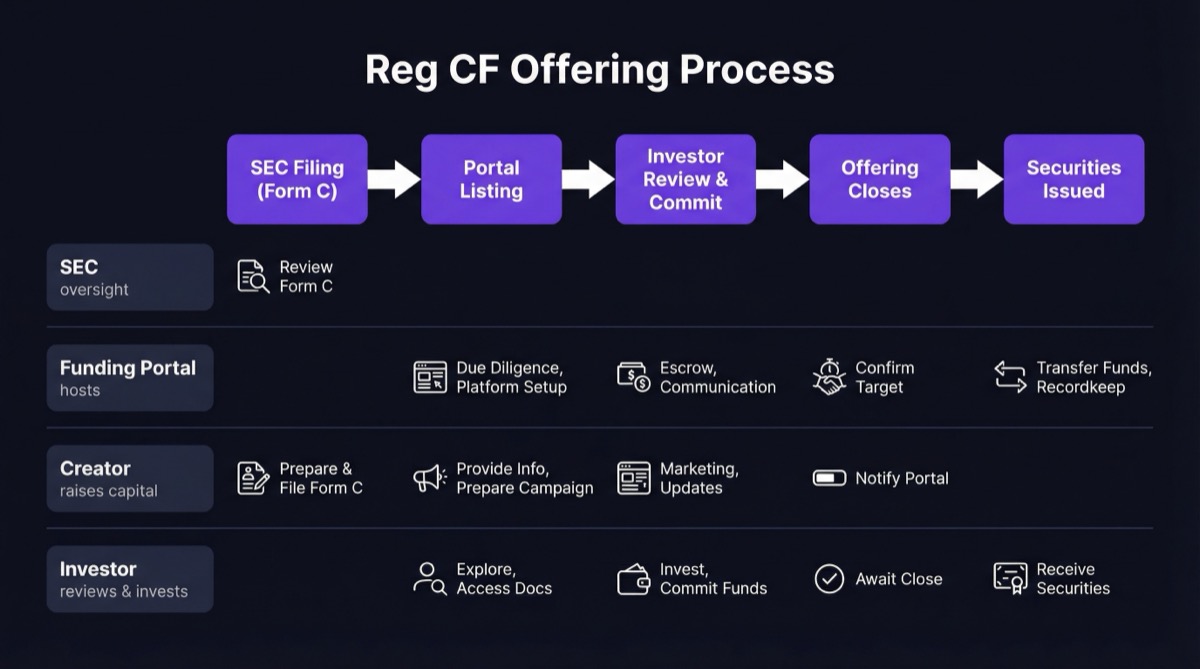
Step 1: The Company Files Form C with the SEC
Before a company can raise capital under Reg CF, it must file a document called Form C with the Securities and Exchange Commission. Form C is the primary disclosure document and contains detailed information about the company, the offering terms, risk factors, use of proceeds, and financial statements. This filing is publicly available on the SEC's EDGAR database, meaning anyone can review it.
Step 2: The Offering Is Listed on a Registered Funding Portal
Once Form C is filed, the offering is listed on an SEC-registered, FINRA-member funding portal. The funding portal is the intermediary between the company and Investors. The portal hosts the offering page, provides educational materials, facilitates communication between the company and potential Investors, and handles compliance requirements.
Step 3: Investors Review Disclosures and Invest
Investors can browse offerings on the funding portal, review the Form C and any supplemental materials, ask questions in the communication channel (which the company is required to monitor and respond to), and make an investment commitment. Each Investor must confirm that they understand the risks, including the potential for total loss of their invested capital.
Step 4: The Offering Closes
An offering closes when it reaches its funding goal, when the posted deadline arrives, or when the company decides to close early (if the minimum target has been met). If the offering does not reach its minimum funding target by the deadline, all investment commitments are returned to Investors.
Step 5: Securities Are Issued
After a successful close, the company issues securities to Investors. In the case of GigaStar Market, these securities are Channel Revenue Tokens (CRTs). At this point, the contractual relationship between the Investor and the company begins, and the terms specified in the offering documents take effect.
Investment Limits Under Reg CF
One of the most important Investor protection mechanisms built into Reg CF is the system of investment limits. These limits are designed to prevent any individual from overcommitting capital to high-risk, early-stage investments.
Investment limits are calculated based on your annual income and net worth, and they apply across all Reg CF offerings combined in a rolling 12-month period -- not per offering.
If Both Your Annual Income and Net Worth Are Below $124,000
You may invest the greater of $2,500 or 5% of the lesser of your annual income or net worth.
For example, if your annual income is $60,000 and your net worth is $80,000, the lesser figure is $60,000. Five percent of $60,000 is $3,000. Since $3,000 is greater than $2,500, your 12-month Reg CF investment limit would be $3,000.
If Either Your Annual Income or Net Worth Is $124,000 or More
You may invest up to 10% of the lesser of your annual income or net worth, with a maximum cap of $124,000 per 12-month period.
For example, if your annual income is $200,000 and your net worth is $150,000, the lesser figure is $150,000. Ten percent of $150,000 is $15,000. Your 12-month limit would be $15,000.
Company Limits
On the issuer side, a company may raise a maximum of $5 million across all Reg CF offerings in any 12-month period. This cap was increased from $1.07 million in the 2021 amendments.
Important Notes on Limits
- These limits are self-certified by the Investor. You are responsible for accurately reporting your income and net worth.
- The limits are aggregate across all Reg CF platforms, not per platform or per offering.
- Accredited Investors are not subject to these limits under Reg CF.
- Investment limits are periodically adjusted by the SEC for inflation.
Required Disclosures: The Form C
The Form C is the cornerstone disclosure document for every Reg CF offering. It is filed with the SEC and made publicly accessible, giving Investors the information they need to make informed decisions.
What Form C Contains
A complete Form C typically includes the following:
- Business description: A detailed overview of the company, its operations, business model, and history.
- Offering terms: The type of security being offered, the price per unit, the minimum and maximum raise amounts, and the offering deadline.
- Risk factors: A candid discussion of the material risks associated with investing in the company and the specific offering. This is one of the most important sections for Investors to read carefully.
- Use of proceeds: How the company intends to use the funds raised. This must be specific enough for Investors to understand the company's priorities.
- Financial statements: Depending on the amount being raised, these may range from tax filings certified by the principal officer (for offerings up to $124,000), to CPA-reviewed statements (up to $618,000), to fully audited financials (over $618,000 or for companies that have previously raised more than $618,000 under Reg CF).
- Ownership and capital structure: Information about the company's officers, directors, and significant shareholders, as well as the existing capital structure.
Why Form C Matters for Due Diligence
The Form C is your primary tool for evaluating a Reg CF offering. It provides standardized, legally required information that allows you to compare offerings, assess risks, and understand exactly what you are purchasing. Unlike marketing materials, the Form C is a regulatory filing, and companies face legal consequences for making materially false or misleading statements in it.
Before investing in any Reg CF offering, including CRTs on GigaStar Market, read the Form C thoroughly. Pay particular attention to the risk factors section, the use of proceeds, and the financial statements. If you have questions, use the communication channel on the funding portal to ask the company directly.
For a more detailed walkthrough, see How to Read a Form C.
The Role of Funding Portals
Funding portals are the registered intermediaries through which Reg CF offerings are conducted. They serve a critical function in the regulatory framework, acting as the bridge between companies seeking capital and Investors evaluating opportunities.
What Funding Portals Do
Funding portals perform several essential functions:
- Host offering pages: Every Reg CF offering is listed on a funding portal, where Investors can access the Form C, offering details, and supplemental materials.
- Provide Investor education: Funding portals are required to provide educational materials that help Investors understand the risks of crowdfunding investments, including the potential for total loss.
- Facilitate communication: Portals must maintain a communication channel where Investors can ask questions and the company can respond. These discussions are visible to all potential Investors.
- Ensure compliance: Portals are responsible for verifying that offerings meet regulatory requirements, that Investor limits are properly calculated, and that cancellation rights are honored.
- Process transactions: Funding portals handle the mechanics of accepting investment commitments and transferring funds.
Registration and Membership Requirements
To operate as a funding portal, an entity must:
- Register with the SEC under Section 4A(a)(1) of the Securities Act.
- Become a member of FINRA (the Financial Industry Regulatory Authority).
- Submit to ongoing regulatory examination and compliance obligations.
These requirements ensure that funding portals operate under meaningful regulatory oversight and are held to established standards of conduct.
GigaStar Market as a Funding Portal
GigaStar Market is an SEC-registered funding portal and FINRA member. It is the platform through which Creator Channel Revenue Token offerings are conducted. As a registered funding portal, GigaStar Market is subject to all Reg CF compliance requirements, including hosting Form C disclosures, maintaining communication channels, providing Investor education, and enforcing investment limits.
FINRA Oversight
The Financial Industry Regulatory Authority (FINRA) plays a central role in the regulation of Reg CF funding portals and broker-dealers involved in crowdfunding securities.
Funding Portal Regulation
FINRA is responsible for examining and regulating funding portals. This includes:
- Registration review: FINRA reviews and processes funding portal membership applications.
- Ongoing examination: Registered funding portals are subject to periodic examination by FINRA to ensure compliance with applicable rules.
- Conduct rules: FINRA has established specific conduct rules for funding portals, covering areas such as advertising, record-keeping, privacy, and handling of Investor complaints.
- Enforcement: FINRA has the authority to take disciplinary action against funding portals that violate rules, including fines, suspensions, or revocation of membership.
Broker-Dealer Requirements
For secondary trading of Reg CF securities, additional regulatory requirements apply. A broker-dealer that operates an Alternative Trading System (ATS) for secondary trading must be separately registered with the SEC and become a FINRA member. This is why GigaStar Securities -- the entity that will operate the Secondary Market for CRTs -- is a separate, registered broker-dealer distinct from GigaStar Market, the funding portal.
Dispute Resolution
FINRA also provides a dispute resolution process. If an Investor has a complaint regarding a funding portal or broker-dealer, FINRA's dispute resolution mechanisms provide a structured avenue for addressing the issue.
Investor Protections Under Reg CF
Reg CF includes several built-in mechanisms designed to protect Investors. While no investment is without risk, these protections provide a regulatory framework that is absent in unregulated markets.
Cancellation Rights
One of the most practical Investor protections under Reg CF is the right to cancel. Investors may withdraw their investment commitment for any reason up to 48 hours before the offering deadline. This provides a cooling-off period and allows Investors to reconsider their decision after committing.
After the 48-hour window, the commitment is generally binding. However, if the company makes a material change to the offering terms during the final 48 hours, Investors are given an additional opportunity to reconfirm or cancel.
Required Annual Reporting
Companies that successfully raise capital under Reg CF are required to file an annual report with the SEC (Form C-AR) no later than 120 days after the end of their fiscal year. This report provides updated financial information and a description of the company's operations. This ongoing disclosure requirement ensures that Investors receive periodic updates about the company's status.
Companies may terminate their annual reporting obligation if they have fewer than 300 record holders, if they have filed at least one annual report and have total assets of $10 million or less, or if the company repurchases or otherwise acquires all outstanding securities.
Disclosure Requirements
As discussed in the Form C section above, the required disclosures ensure that Investors have access to standardized, material information before committing capital. This is a significant protection compared to unregulated investment opportunities where information may be incomplete or misleading.
Investment Limits as Built-In Protection
The annual investment limits described earlier serve as a regulatory backstop, preventing any single Investor from overallocating to Reg CF offerings relative to their financial situation. While Investors are ultimately responsible for their own decisions, the limits create a structural safeguard against excessive exposure to this asset class.
How Reg CF Applies to CRT Offerings
Channel Revenue Tokens (CRTs) offered on GigaStar Market are Reg CF securities. This means every CRT offering is subject to the full set of Reg CF rules and requirements.
GigaStar Market Is the Funding Portal
All primary CRT offerings are conducted through GigaStar Market, an SEC-registered funding portal and FINRA member. GigaStar Market hosts the offering pages, maintains the required communication channels, provides Investor education, and processes investment commitments.
Creators File Form C
Each Creator who raises capital through a CRT offering files a Form C with the SEC. This document contains the specific terms of the CRT, including the revenue-sharing percentage, the duration of the revenue-sharing period, the maximum raise amount, risk factors, and financial information. Investors can access these filings on both the GigaStar Market platform and through the SEC's EDGAR database.
CRTs Are Reg CF Securities
CRTs are securities as defined under federal securities law and are offered under the Reg CF exemption. This classification means that all Reg CF rules apply: investment limits, disclosure requirements, cancellation rights, annual reporting, and the requirement to conduct offerings through a registered funding portal.
All CRT Offerings Follow Reg CF Rules
There is no special exemption for CRTs. Every CRT offering must comply with:
- Filing a complete Form C with the SEC
- Conducting the offering exclusively through an SEC-registered funding portal
- Enforcing Investor investment limits
- Honoring cancellation rights
- Filing annual reports after a successful raise
This regulatory framework provides the same structure and protections that apply to any other Reg CF offering across any industry.
Limitations and Risks of Reg CF Investments
While Reg CF provides meaningful regulatory structure and Investor protections, it is important to understand the limitations and risks inherent in this type of investing.
Illiquidity
Reg CF securities are subject to a 12-month resale restriction from the date of purchase. During this period, you generally cannot sell your securities, with limited exceptions (such as transfers to family members, in estate distributions, or back to the issuer). Even after the 12-month period, resale depends on the existence of a willing buyer and a venue for the transaction.
Higher Risk Than Public Market Securities
Companies that raise capital under Reg CF are typically earlier-stage, smaller enterprises with less established track records compared to publicly traded companies. The risk of total loss is materially higher than for diversified public market investments.
Limited Financial Reporting
Compared to publicly traded companies, which must file extensive periodic and annual reports, Reg CF issuers have comparatively lighter reporting obligations. The annual report requirement provides some ongoing transparency, but it is far less detailed than what public companies must disclose. This information asymmetry means Investors have less data to work with when evaluating ongoing performance.
Possible Total Loss
As with any investment in early-stage or alternative securities, there is a real possibility that you may lose your entire invested capital. Revenue-based securities like CRTs depend on the ongoing performance of the underlying Creator and their revenue stream. If the Creator's revenue declines significantly or ceases entirely, distributions may be reduced or eliminated, and the value of the security could fall to zero.
For a detailed discussion of the specific risks associated with CRT investments, see Risk Factors in Creator Investing.
The Secondary Market and Reg CF Securities
One of the historical challenges with Reg CF securities has been the lack of liquidity after the initial offering. The 12-month resale restriction and the absence of organized trading venues meant that Investors were generally committed for the full duration of the investment.
The 12-Month Holding Period
Under SEC rules, securities purchased in a Reg CF offering cannot be resold for 12 months from the date of purchase, except in limited circumstances:
- Transfers to the issuer of the securities
- Transfers to an accredited Investor
- Transfers to a family member
- Transfers in connection with death or divorce
- Transfers registered with the SEC
After 12 months, the restriction lifts and the securities may be freely resold, provided there is a venue and a willing buyer.
The GigaStar Secondary Market
GigaStar Securities, a FINRA-member broker-dealer, is launching an SEC-registered Alternative Trading System (ATS) on March 16, 2026 for secondary trading of CRTs. This market will provide a structured, regulated venue where eligible CRT holders can list their tokens for sale and where buyers can place orders to purchase.
The existence of a secondary market does not mean there will always be a buyer for your CRTs at a price you find acceptable. Liquidity is not assured, and market prices will be determined by supply and demand dynamics. However, the ATS does provide infrastructure that did not previously exist for CRT holders who wish to explore selling their positions.
For a comprehensive overview of how the Secondary Market works, see The GigaStar Secondary Market: Complete Guide.
Key Takeaways
- Reg CF is the legal framework that allows companies, including Creators, to raise capital from the general public through SEC-registered funding portals.
- Investment limits protect Investors from overallocating to Reg CF offerings based on their income and net worth.
- Form C is the essential disclosure document that provides the information you need to evaluate any offering. Read it carefully before investing.
- Funding portals like GigaStar Market are SEC-registered and FINRA-member intermediaries that host offerings, provide education, and ensure compliance.
- Investor protections include cancellation rights, mandatory disclosures, investment limits, and annual reporting requirements.
- CRT offerings are Reg CF securities subject to all the same rules and protections as any other Reg CF offering.
- Risks are real: illiquidity, limited reporting, and the potential for total loss are inherent characteristics of Reg CF investments.
- The Secondary Market launching March 16, 2026 will provide a regulated venue for CRT resale after the 12-month holding period, but liquidity is not assured.
Frequently Asked Questions
What is SEC Regulation Crowdfunding?
SEC Regulation Crowdfunding (Reg CF) is a federal securities regulation enacted under the JOBS Act of 2012 and effective since May 2016. It allows companies to raise up to $5 million in a 12-month period from both accredited and non-accredited Investors through SEC-registered funding portals. The 2021 amendments raised the cap from $1.07 million and updated several other provisions. Reg CF is the regulation under which all CRT offerings on GigaStar Market are conducted.
What are the investment limits under Reg CF?
Investment limits depend on your annual income and net worth. If both are below $124,000, you may invest the greater of $2,500 or 5% of the lesser of your income or net worth. If either is $124,000 or more, you may invest up to 10% of the lesser, capped at $124,000 per year. These limits apply across all Reg CF offerings combined, not per platform or per offering. They are self-certified, so Investors are responsible for tracking their own aggregate commitments.
What disclosures are required in a Reg CF offering?
Companies must file Form C with the SEC before conducting an offering. Form C includes the business description, offering terms, risk factors, planned use of proceeds, financial statements (the rigor of which scales with the amount being raised), and information about officers, directors, and significant shareholders. This filing is publicly available on the SEC's EDGAR database and is hosted on the funding portal where the offering is listed.
How are Investors protected under Regulation Crowdfunding?
Reg CF provides multiple layers of Investor protection: mandatory disclosure through Form C, annual investment limits calculated from income and net worth, the right to cancel investments up to 48 hours before the offering deadline, required annual reporting by issuers, and the requirement that all offerings be conducted through SEC-registered, FINRA-member funding portals. While these protections reduce certain risks, they do not eliminate the potential for loss.
Can I cancel my Reg CF investment?
Yes. Investors may cancel their investment commitment for any reason up to 48 hours before the offering deadline. After that 48-hour window, the commitment is generally binding. If the company makes a material change to the offering during the final 48 hours, Investors receive notice and must reconfirm their commitment within five business days or the commitment is automatically canceled.
How do Reg CF rules apply to Channel Revenue Tokens?
CRTs are securities offered under Reg CF through GigaStar Market, an SEC-registered funding portal. Every CRT offering requires a Form C filing with the SEC, is subject to Investor investment limits, provides cancellation rights, and is followed by annual reporting obligations. CRTs are also subject to the 12-month resale restriction that applies to all Reg CF securities. There is no special exemption or different treatment for CRTs under Reg CF rules.
This content is for educational purposes only and does not constitute investment advice. CRT investments involve significant risk, including potential total loss of invested capital. Past performance does not predict future results.
Sources
- U.S. Securities and Exchange Commission. "Regulation Crowdfunding." SEC.gov. https://www.sec.gov/resources-small-businesses/exempt-offerings/regulation-crowdfunding
- U.S. Securities and Exchange Commission. "SEC Adopts Rules to Permit Crowdfunding." SEC Press Release, October 2015. https://www.sec.gov/news/pressrelease/2015-249.html
- U.S. Securities and Exchange Commission. "Updated Investor Bulletin: Crowdfunding Investment Limits Increase." Investor.gov, October 2022. https://www.investor.gov/introduction-investing/general-resources/news-alerts/alerts-bulletins/investor-bulletins-53
- FINRA. "Funding Portals." FINRA.org. https://www.finra.org/registration-exams-ce/funding-portals
- FINRA. "Learn About Regulatory Oversight of Funding Portals." FINRA.org. https://www.finra.org/registration-exams-ce/funding-portals/learn-about-regulatory-oversight-funding-portals
- FINRA. "Frequently Asked Questions (FAQs) on Regulation Crowdfunding." FINRA.org. https://www.finra.org/registration-exams-ce/funding-portals/faq-regulation-crowdfunding