The GigaStar Secondary Market: Complete Guide
What is the GigaStar Secondary Market?
The GigaStar Secondary Market is an SEC-registered Alternative Trading System (ATS) launching March 16, 2026, where CRT holders can potentially buy and sell their positions to other investors.
Educational Content: This content is for educational purposes only and does not constitute investment advice. All investments involve risk, including potential loss of principal. See full disclosures.
What Is the GigaStar Secondary Market?
The GigaStar Secondary Market is an SEC-registered Alternative Trading System (ATS) designed specifically for trading Channel Revenue Tokens (CRTs). Operated by GigaStar Securities, a FINRA-member broker-dealer, the Secondary Market will give existing CRT holders the ability to list their positions for sale and allow new or existing Investors to purchase CRTs from other holders rather than from a primary offering.
Until now, Investors who purchased CRTs through GigaStar Market (the funding portal) have held their tokens with no structured way to sell before the revenue-sharing period ends. The Secondary Market changes that by providing a regulated venue where buy and sell orders can be matched, subject to eligibility requirements and market conditions.
The platform is scheduled to launch on March 16, 2026. This guide walks through everything you need to know: how the market works, what the eligibility rules are, how to prepare your account, and what risks to keep in mind.
Key distinction: GigaStar Market is the SEC-registered funding portal where Creators raise capital through primary offerings. GigaStar Securities is the FINRA-member broker-dealer that operates the Secondary Market ATS. These are separate entities with separate accounts.
Why the Secondary Market Matters
One of the most significant characteristics of CRT investments has been their illiquidity. When you purchased CRTs through a primary offering on GigaStar Market, you committed capital for the full duration of the revenue-sharing period with no structured mechanism to exit early. The Secondary Market addresses this limitation, though it comes with important caveats.
Potential Liquidity for Existing Holders
The Secondary Market creates a venue where CRT holders who meet eligibility requirements can list their tokens for sale. This does not mean there will always be a buyer at a price you find acceptable, but it does mean there will be infrastructure in place to facilitate transactions.
Price Discovery
Without a secondary trading venue, CRTs have no observable market price beyond their original offering price. The Secondary Market introduces a mechanism for price discovery, where the interaction of buy and sell orders establishes a current market price for each CRT. This price will reflect the collective assessment of Investors regarding the value of a specific Creator's revenue stream.
Broader Access for New Investors
Some CRT offerings that were fully subscribed during their primary raise will become accessible again through the Secondary Market. Investors who missed a primary offering or who want to increase their position in a specific Creator can potentially do so by purchasing from existing holders.
Ecosystem Maturation
A functioning secondary market is a hallmark of a maturing asset class. It provides signals about Investor confidence, Creator performance, and the overall health of the Creator Economy investment ecosystem.
How the Secondary Market Works
The GigaStar Secondary Market operates as an Alternative Trading System, a specific type of SEC-registered trading venue. Understanding its mechanics helps set appropriate expectations.
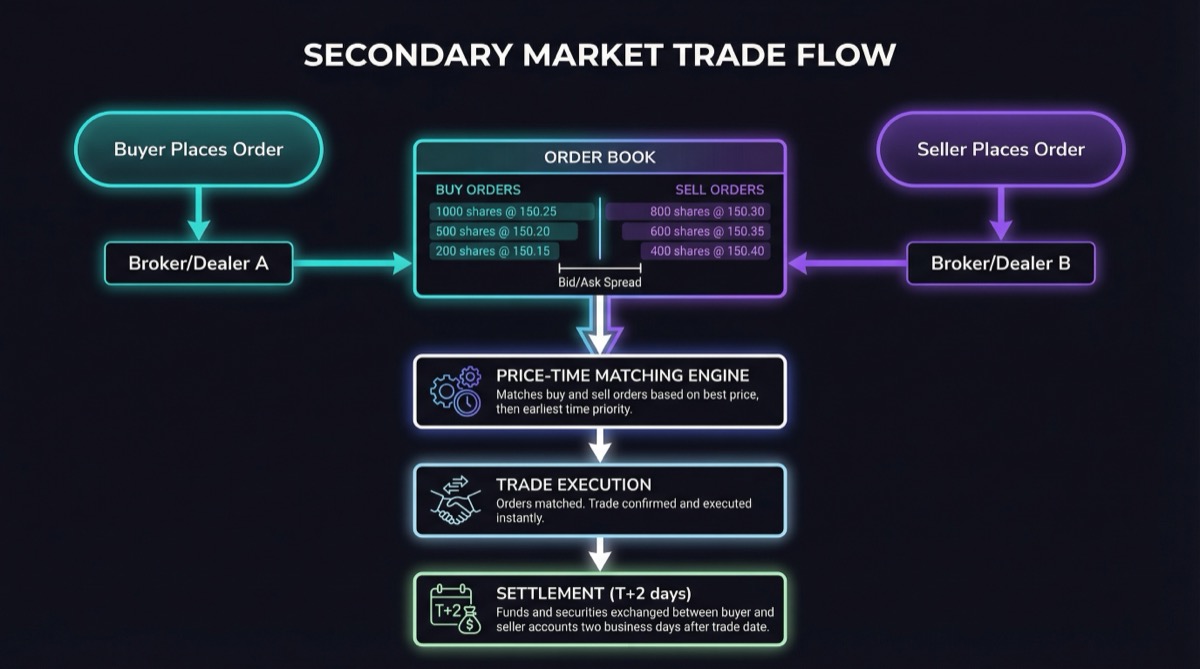
Order Placement
Investors interact with the Secondary Market by placing orders through their GigaStar Securities account. There are two basic order types:
- Sell orders: Existing CRT holders who meet the eligibility requirements can list their tokens for sale at a specified price (a limit order) or at the best available market price.
- Buy orders: Investors with funded GigaStar Securities accounts can place orders to purchase specific CRTs at a specified price or at the best available market price.
Order Matching
The ATS uses a price-time priority matching system. This means:
- Price priority: The best-priced orders are matched first. Buy orders at higher prices and sell orders at lower prices take priority.
- Time priority: When multiple orders are at the same price, the order placed first is matched first.
This is the same matching methodology used by most major trading venues and provides a transparent, rules-based approach to trade execution.
Trade Settlement
Once a buy order and a sell order are matched, the trade is executed. Settlement involves the transfer of CRTs from the seller to the buyer, and the transfer of funds from the buyer to the seller. The specific settlement timeline will be announced closer to launch.
Market Hours
The Secondary Market will operate during defined trading hours. Specific hours of operation will be published before the launch date. Orders may be placed outside of trading hours for execution when the market opens.
Eligibility Requirements
Not every CRT can be traded immediately, and not every Investor can participate in every transaction. Understanding the eligibility framework is essential.
Selling Eligibility
To sell CRTs on the Secondary Market, the following conditions must be met:
- 12-month holding period: CRTs must have been held for a minimum of 12 months from the original purchase date. This requirement is rooted in federal securities regulations governing the resale of Reg CF securities.
- Active GigaStar Securities account: The seller must have an open, verified account with GigaStar Securities (the broker-dealer), not just a GigaStar Market (funding portal) account.
- CRT status: The CRTs must be in good standing, meaning the underlying offering has closed and the revenue-sharing agreement is active.
If you purchased CRTs at different times across multiple offerings, each purchase has its own 12-month clock. You may be eligible to sell some holdings before others.
Buying Eligibility
The requirements for buyers are more straightforward:
- Verified GigaStar Securities account: You must have a funded, verified account with GigaStar Securities.
- Identity verification: Standard KYC (Know Your Customer) and AML (Anti-Money Laundering) verification must be complete.
- Sufficient funds: Your account must have adequate funds to cover the purchase price plus any applicable fees.
There are no additional holding period requirements for purchasing CRTs on the Secondary Market.
Investment Limits
SEC Regulation Crowdfunding investment limits apply to primary offerings on the funding portal. Whether and how investment limits apply to secondary market transactions will be clarified in the operational documentation provided before launch. Investors should review all applicable limits and disclosures.
Account Migration to GigaStar Securities
Because the primary market (GigaStar Market) and the Secondary Market (GigaStar Securities) are operated by separate entities, Investors need to take specific steps to prepare for secondary trading.
Why Two Separate Accounts?
- GigaStar Market is the SEC-registered funding portal where Creators raise capital through primary CRT offerings under Reg CF. It is operated by GigaStar Portal, LLC.
- GigaStar Securities is the FINRA-member broker-dealer that operates the ATS for secondary trading. It is a separate legal entity with its own regulatory requirements.
Federal securities regulations require that trading on an ATS be conducted through a broker-dealer. This is why a separate account is necessary.
The Migration Process
To participate in the Secondary Market, you will need to:
- Open a GigaStar Securities account by completing the application and providing required documentation.
- Complete identity verification through the GigaStar Securities KYC process.
- Agree to the broker-dealer account terms, which are distinct from your funding portal terms.
- Link your CRT holdings so that your existing tokens are recognized in the new system.
For detailed migration instructions, see Account Migration to GigaStar Securities.
What Stays the Same
Migrating your account does not change the fundamental nature of your CRT holdings. Your revenue-sharing terms remain the same. Your monthly distributions continue on the same schedule. The Creators you have invested in are the same. Migration is an account-level change, not an investment-level change.
The Regulatory Framework
The Secondary Market operates within a comprehensive regulatory framework designed to protect Investors.
SEC Registration
The ATS is registered with the Securities and Exchange Commission under Regulation ATS. This registration requires GigaStar Securities to:
- File Form ATS with the SEC, disclosing the system's operations
- Maintain fair access policies
- Implement safeguards to protect confidential trading information
- Comply with record-keeping and reporting requirements
FINRA Oversight
As a FINRA-member broker-dealer, GigaStar Securities is subject to ongoing regulatory oversight, including:
- Examination and audit requirements: FINRA conducts periodic examinations of broker-dealer operations.
- Conduct rules: GigaStar Securities must adhere to FINRA rules governing fair dealing, suitability, and communications with the public.
- Dispute resolution: Investors have access to FINRA's arbitration and mediation processes for resolving disputes.
Investor Protections
The regulatory framework provides several layers of protection:
- Transparency: Trade data and pricing information must be reported and made available according to regulatory requirements.
- Fair access: The ATS must provide fair access to Investors who meet eligibility criteria, without unfair discrimination.
- Confidentiality: Trading information and account data are protected under securities regulations and privacy laws.
- Compliance monitoring: Both internal compliance teams and external regulators monitor for market manipulation, insider trading, and other prohibited activities.
For a deeper dive into how ATS regulation works, see What Is an Alternative Trading System?.
What to Expect at Launch
Setting realistic expectations for the Secondary Market launch is important. This is a new market for a relatively new asset class, and early conditions may differ from what you might expect from more established markets.
Beta Period
The initial launch period will function as a beta phase. During this time:
- Trading volume may be limited: With a new market and a 12-month holding requirement, the initial supply of eligible CRTs may be modest.
- Spreads may be wide: The difference between the highest buy order price and the lowest sell order price (the bid-ask spread) may be significant during the early days as the market establishes pricing norms.
- Operational adjustments: GigaStar Securities may make adjustments to trading rules, hours, and procedures based on real-world experience during the beta.
Limited Initial Liquidity
Liquidity, the ability to buy or sell quickly at a reasonable price, takes time to develop in any new market. Several factors will influence early liquidity:
- The number of Investors who have completed account migration to GigaStar Securities
- The volume of CRTs that have passed the 12-month holding period
- Overall Investor interest in specific Creators
- The number of active buy and sell orders in the system
Phased Rollout
Not all CRTs may be available for trading on day one. GigaStar Securities may implement a phased approach, initially enabling trading for a subset of CRT offerings and expanding over time as the market infrastructure is validated.
Communication and Support
GigaStar Securities will provide educational materials, tutorials, and support resources in advance of and during the launch. Investors are encouraged to familiarize themselves with the trading interface and operational procedures before placing their first orders.
Pricing and Valuation on the Secondary Market
One of the most common questions about the Secondary Market concerns pricing. How will CRTs be priced, and what factors will influence their value?
Supply and Demand
Like any market, CRT prices on the Secondary Market will be determined by the interaction of supply (sellers) and demand (buyers). There is no fixed price or formula. The price at which a transaction occurs is simply the price at which a willing buyer and a willing seller agree.
Factors That May Affect Price
Several factors may influence what Investors are willing to pay or accept for CRTs:
- Creator channel performance: Channels with growing viewership and revenue may command higher prices. Channels experiencing declining metrics may see lower demand.
- Historical distributions: The track record of monthly distributions provides data that Investors can evaluate, though past performance does not predict future results.
- Remaining revenue-sharing term: CRTs with more time remaining on their revenue-sharing agreement represent more potential future distributions than those nearing expiration.
- Overall market conditions: Broader economic conditions, interest rates, and Investor sentiment toward alternative investments may all play a role.
- YouTube platform changes: Changes to YouTube's monetization policies, ad rates, or algorithms could affect Investor perceptions of CRT value across the board.
No Guaranteed Relationship to Original Price
It is important to understand that Secondary Market prices may be higher or lower than the original purchase price from the primary offering. There is no mechanism that guarantees you will be able to sell your CRTs at or above the price you originally paid. The market determines the price based on current conditions and Investor sentiment.
Price Transparency
The ATS will provide transparency into order book activity and recent transaction prices, subject to regulatory requirements. This information helps Investors make informed decisions about order placement and pricing.
Key Risks and Considerations
The Secondary Market introduces new opportunities but also carries risks that every Investor must understand before participating.
No Guaranteed Liquidity
The existence of a Secondary Market does not guarantee that you will be able to sell your CRTs when you want to or at a price you find acceptable. Liquidity depends on there being a counterparty, a buyer willing to purchase at or near your asking price. In a new market with limited participants, matching may take time, and some orders may never be filled.
Price Below Original Purchase
CRT prices on the Secondary Market may be lower than what you originally paid in the primary offering. If a Creator's channel has underperformed, if broader market conditions are unfavorable, or if there are simply more sellers than buyers, prices can decline. You should be prepared for the possibility of selling at a loss.
Counterparty Requirements
Every trade requires a counterparty. There must be a buyer for every seller and a seller for every buyer. In a market with limited participants, this is not always available. You may place a sell order that sits unfilled for an extended period.
Operational and Technology Risk
As with any technology-based platform, the Secondary Market may experience downtime, technical issues, or operational disruptions. While GigaStar Securities will implement robust systems, no platform is immune to technical challenges.
Regulatory Risk
Securities regulations may change. New rules or interpretations could affect how the Secondary Market operates, what can be traded, or what disclosures are required. While the current regulatory framework is well-established, Investors should be aware that the regulatory landscape can evolve.
Tax Implications
Selling CRTs on the Secondary Market may trigger taxable events. The tax treatment of CRT sales may vary based on your holding period, the gain or loss on the transaction, and your individual tax situation. Consult a qualified tax professional for guidance specific to your circumstances.
How to Prepare: Your Pre-Launch Checklist
With the March 16, 2026 launch approaching, here are the steps you can take to prepare:
1. Review Your Current Holdings
Log into your GigaStar Market account and review your CRT portfolio. Note:
- Which CRTs you hold
- The original purchase dates for each
- Whether each holding has passed the 12-month mark (or when it will)
2. Open a GigaStar Securities Account
Begin the account migration process early. Visit GigaStar Securities to:
- Complete the account application
- Provide required identity verification documents
- Review and accept the broker-dealer account terms
3. Complete Identity Verification
Ensure your KYC verification is complete well before launch day. Identity verification can take several business days, and starting early avoids delays.
4. Fund Your Account
If you plan to buy CRTs on the Secondary Market, ensure your GigaStar Securities account is funded. Review the available funding methods and processing times.
5. Educate Yourself
Read through all available educational materials about Secondary Market operations, including:
- What Is an Alternative Trading System?
- Account Migration to GigaStar Securities
- Trading rules and procedures documentation (forthcoming)
6. Set Realistic Expectations
Understand that the early days of the Secondary Market may feature limited liquidity, wide bid-ask spreads, and evolving operational procedures. This is normal for any new trading venue and should improve over time as participation grows.
7. Decide Your Strategy
Consider what you want to accomplish:
- Are you planning to sell some or all of your holdings?
- Are you looking to buy additional CRTs?
- Are you taking a wait-and-see approach?
Having clarity about your goals before the market opens will help you act with intention rather than reacting to early market conditions.
Key Takeaways
- The GigaStar Secondary Market is an SEC-registered Alternative Trading System (ATS) operated by GigaStar Securities, a FINRA-member broker-dealer, launching March 16, 2026.
- Selling requires a 12-month holding period from the original purchase date. Buying is open to all verified GigaStar Securities account holders.
- Account migration is required: You need a separate GigaStar Securities account (distinct from your GigaStar Market funding portal account) to participate.
- Prices are determined by supply and demand, not by a fixed formula. CRTs may trade above or below their original offering price.
- Liquidity is not guaranteed: The Secondary Market creates the infrastructure for trading, but actual liquidity depends on Investor participation.
- Monthly distributions continue as normal for CRT holders. Selling transfers distribution rights to the new holder.
- Early conditions will differ from mature markets: Expect limited initial liquidity, potentially wide spreads, and a phased rollout during the beta period.
- Regulatory protections are in place: SEC registration, FINRA oversight, fair access rules, and transparency requirements protect Investors.
Frequently Asked Questions
When does the GigaStar Secondary Market launch?
The Secondary Market is scheduled to launch on March 16, 2026. This date is subject to change based on regulatory and operational readiness.
Do I need a new account to trade on the Secondary Market?
Yes. You will need to open an account with GigaStar Securities, the broker-dealer operating the ATS. This is separate from your GigaStar Market funding portal account. See Account Migration to GigaStar Securities for step-by-step instructions.
Can I sell my CRTs immediately when the Secondary Market opens?
Only CRTs held for 12 months or more are eligible for resale. Check your original purchase dates to determine eligibility. If you purchased CRTs in March 2025 or earlier, those holdings would be eligible at launch.
Is there a minimum trade size on the Secondary Market?
Specific minimum trade sizes and other operational details will be announced closer to the launch date. Watch for communications from GigaStar Securities with finalized trading rules.
Will my distributions continue if I hold my CRTs?
Yes. Monthly distributions continue as normal for CRT holders. The Secondary Market does not change the revenue-sharing terms of your existing holdings. If you sell your CRTs, the distribution rights transfer to the new holder from the point of sale forward.
This content is for educational purposes only and does not constitute investment advice. All investments involve risk, including the potential loss of your entire investment.