Risk Factors in Creator Investing: Complete Analysis
What are the risks of investing in Channel Revenue Tokens?
CRT investments carry significant risks including potential total loss, Creator performance decline, YouTube policy changes, revenue variability, and illiquidity. Investors should only invest what they can afford to lose.
Educational Content: This content is for educational purposes only and does not constitute investment advice. All investments involve risk, including potential loss of principal. See full disclosures.
Why Risk Education Matters
Investing in Channel Revenue Tokens (CRTs) is fundamentally different from buying shares of a large public company or a diversified index fund. CRTs are securities tied to the potential future revenue of individual YouTube Creators. They operate in a relatively new market segment, under a regulatory framework that is still evolving, and with characteristics that make them inherently speculative.
This article exists because every Investor considering a CRT investment deserves a thorough, honest assessment of what can go wrong. Risk education is not a formality or a disclaimer to skim past. It is the foundation of informed investing. The Investors who fare best in any market are the ones who understand the downside before committing capital.
CRTs are offered under SEC Regulation Crowdfunding through GigaStar Market, an SEC-registered funding portal and FINRA member. Every offering includes a Form C filing with the SEC that contains a detailed risk factors section. Before investing in any CRT, you should read the Form C in its entirety, paying particular attention to those risk factors. The information in this article is educational and general in nature. It does not replace the specific risk disclosures in individual offering documents.
The risks described below are real, material, and have the potential to result in the complete loss of your invested capital. Understanding them is not optional.
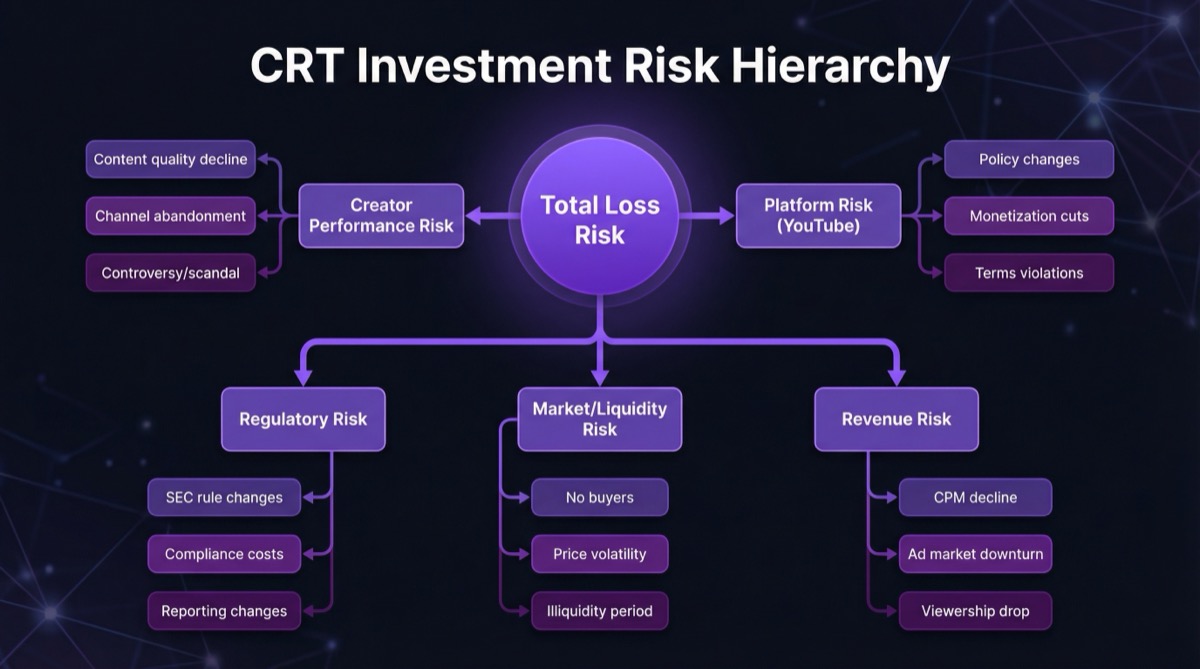
Total Loss Risk
The most important risk to internalize is this: you can lose your entire investment. Every dollar you put into a CRT could be gone permanently, with no mechanism for recovery.
This is not a theoretical or remote possibility. It is a realistic outcome that every CRT Investor must accept before investing. CRTs are backed by a Creator's YouTube revenue. If that revenue stream dries up for any reason, the investment has no residual value. There is no underlying physical asset to liquidate, no corporate balance sheet to fall back on, and no insurance program that protects CRT holders.
Scenarios that could lead to total loss include:
- A Creator permanently stops producing content. Whether due to burnout, personal circumstances, career change, or any other reason, a Creator who ceases uploads will see their channel's revenue decline and eventually reach zero.
- A Creator's channel is terminated by YouTube. Repeated policy violations, copyright strikes, or community guideline violations can result in channel termination, which eliminates the revenue stream entirely.
- Revenue declines to a negligible level. Even if a Creator continues posting, shifts in audience behavior, algorithm changes, or declining content quality could reduce revenue to near zero.
- Regulatory or structural changes. Changes in how YouTube compensates Creators, or changes in the regulatory framework governing CRTs, could fundamentally alter the economics of the investment.
There is no minimum distribution guarantee. There is no principal protection. If the underlying revenue stream fails, the investment fails. Investors should approach every CRT investment with the understanding that total loss is a possible outcome.
Creator Performance Risk
When you invest in a CRT, you are investing in a specific Creator's ability and willingness to consistently produce content that generates YouTube revenue. This introduces a range of performance-related risks that do not exist in more traditional investments.
Content Quality and Consistency
A Creator's revenue is driven by views, and views are driven by content. If a Creator's content quality declines, if they reduce their upload frequency, or if they shift to content that their audience does not engage with, viewership can drop. Declining viewership means declining revenue, which means declining distributions.
Content quality is subjective and can change over time. A Creator who produced compelling content for years may lose their creative edge. A format that resonated with audiences in one period may become stale in another. There is no contractual mechanism that requires a Creator to maintain a specific level of content quality or output.
Creator Burnout
Content creation is demanding work. Creators face pressure to publish consistently, engage with audiences, stay current with trends, and manage the business side of their channels. Burnout is a well-documented phenomenon in the Creator Economy. A Creator experiencing burnout may reduce their output, take extended breaks, produce lower-quality content, or quit entirely.
Burnout is difficult to predict from the outside. A Creator may appear productive and engaged at the time of the offering but experience burnout months or years later. This risk is inherent to any investment tied to an individual's ongoing creative output.
Audience Migration
Audiences are not captive. Viewers who follow a Creator today may shift their attention to competing Creators, new platforms, or entirely different forms of media. A Creator's subscriber count does not guarantee future viewership. Subscribers may become inactive, and new audience acquisition may slow or stop.
Niche competition is a related factor. If a Creator operates in a niche that becomes saturated with similar content, their share of the available audience may decline even if the total niche audience grows.
Reputational Risk
A Creator's public reputation directly affects their channel. Controversies, public statements, associations, or behaviors that audiences or advertisers find objectionable can lead to rapid audience loss and advertiser withdrawal. YouTube may also age-restrict or limit the distribution of content from Creators involved in controversies, further reducing revenue.
Reputational damage can happen suddenly and with little warning. A single incident can fundamentally alter a Creator's trajectory. Investors have no control over a Creator's conduct and no ability to mitigate this risk once it materializes.
For a deeper analysis of these factors, see Creator Performance Risk Explained.
YouTube Platform Risk
Every CRT investment is ultimately dependent on YouTube as a platform. YouTube is the source of the revenue that backs CRT distributions, and Investors have zero control over YouTube's business decisions.
Algorithm Changes
YouTube's recommendation algorithm is the primary driver of video discovery. Changes to the algorithm can dramatically affect a Creator's viewership, either positively or negatively. YouTube does not notify Creators in advance of algorithm changes, and the algorithm's inner workings are not publicly documented. A Creator who benefits from the current algorithm may be disadvantaged by a future iteration.
Demonetization
YouTube can demonetize individual videos or entire channels if they are deemed to violate YouTube's monetization policies. Demonetization means the Creator earns no ad revenue from the affected content. Demonetization decisions can be broad, sometimes affecting entire content categories. A Creator whose content is demonetized will generate reduced or zero revenue, directly impacting CRT distributions.
YouTube's monetization policies evolve over time. Content that is monetizable today may not be monetizable tomorrow if YouTube updates its advertiser-friendly content guidelines.
Revenue Share Changes
YouTube currently shares a percentage of ad revenue with Creators through the YouTube Partner Program. This percentage is set by YouTube and could be changed at YouTube's discretion. If YouTube reduces the share of revenue paid to Creators, all CRT holders would be affected regardless of the individual Creator's performance.
Platform Viability
While YouTube is currently the dominant video-sharing platform, the digital media landscape is competitive and evolving. There is no guarantee that YouTube will maintain its current market position, its current business model, or its current revenue-sharing arrangements with Creators. Although a sudden disappearance of YouTube is unlikely, gradual shifts in the platform's economics or relevance are plausible over longer time horizons.
Ad Market Conditions
YouTube ad revenue is tied to the broader digital advertising market. Economic downturns, changes in advertiser spending, shifts in ad buying preferences, and competitive pressure from other platforms can all affect the ad rates that YouTube can charge. Lower ad rates mean lower Creator revenue, which means lower CRT distributions.
Revenue Variability
CRT distributions are not fixed payments. They fluctuate based on the Creator's actual YouTube revenue, which varies from month to month and year to year. Investors should expect variability and should not plan their finances around receiving consistent distribution amounts.
Seasonal Patterns
YouTube ad rates follow seasonal patterns. The fourth quarter of each calendar year typically sees the highest CPMs (cost per thousand impressions) as advertisers increase spending for the holiday season. The first quarter typically sees a decline as advertising budgets reset. This means distributions may be noticeably higher in some months and lower in others, even if the Creator's viewership remains stable.
View Count Fluctuations
A Creator's view count can vary significantly based on the specific content they publish, trends in their niche, external events, and audience behavior. A viral video can spike views temporarily, while a series of underperforming videos can create a prolonged dip. These fluctuations translate directly to revenue and distribution variability.
CPM Variability
Even with stable viewership, the revenue per view can change. CPMs are influenced by advertiser demand, the Creator's content category, viewer demographics, and broader economic conditions. A Creator in a high-CPM niche today may see CPMs decline if advertisers shift budgets to different categories.
No Fixed Distribution Schedule Guarantee
While GigaStar aims to process distributions on a monthly basis, the actual distribution amounts are determined by real revenue data. If there are delays in YouTube reporting or other operational factors, the timing of distributions may vary. The key point is that distributions are revenue-dependent, not time-fixed.
Illiquidity Risk
CRT investments are illiquid. This means you cannot easily convert your investment to cash whenever you choose. This is a critical characteristic that differentiates CRTs from publicly traded securities.
No Immediate Exit
When you invest in a CRT through a primary offering on GigaStar Market, you are committing capital for an indefinite period. There has historically been no structured mechanism to sell your CRTs before the revenue-sharing period ends.
The 12-Month Holding Period
Under federal securities regulations governing Reg CF securities, CRTs cannot be resold until at least 12 months after the original purchase. This is a legal requirement, not a GigaStar policy, and there are no exceptions.
Secondary Market Limitations
The GigaStar Secondary Market, operated by GigaStar Securities (a FINRA-member broker-dealer), is scheduled to launch on March 16, 2026. This Alternative Trading System (ATS) will provide a venue for buying and selling CRTs that meet eligibility requirements. However, the existence of a Secondary Market does not guarantee liquidity.
Early market conditions are likely to feature limited trading volume, a small number of participants, and potentially wide bid-ask spreads. You may list your CRTs for sale and find no buyer. You may find a buyer only at a price significantly below what you paid. The Secondary Market is a positive development for the CRT ecosystem, but it does not transform CRTs into liquid investments.
For a detailed analysis of illiquidity considerations, see Understanding Illiquidity in CRT Investments.
Regulatory and Legal Risk
CRT investments exist within a regulatory framework that could change. These changes could affect the economics of CRT investing, the operations of GigaStar, or the rights of Investors.
Regulation Crowdfunding Changes
CRTs are offered under SEC Regulation Crowdfunding (Reg CF). Congress or the SEC could modify the Reg CF framework in ways that affect future offerings, secondary trading, investment limits, or disclosure requirements. While the current regulatory environment supports CRT offerings, there is no guarantee that the regulatory landscape will remain static.
Tax Treatment
The tax treatment of CRT distributions and any gains or losses from secondary market transactions is subject to current tax law, which can change. Investors should consult qualified tax advisors about their specific situations, as changes in tax law could affect the after-tax economics of CRT investments.
Platform Regulatory Risk
GigaStar Market operates as an SEC-registered funding portal and FINRA member. GigaStar Securities operates as a FINRA-member broker-dealer. Both entities are subject to ongoing regulatory oversight. Changes in regulatory requirements, enforcement actions, or operational challenges could affect GigaStar's ability to operate, process distributions, or facilitate secondary market trading.
Legal Disputes
Any investment structure involves the potential for legal disputes. Disagreements between Creators, GigaStar, and Investors, or challenges from regulators, could create uncertainty and cost. While the legal framework is designed to be clear, no legal structure is immune from disputes.
Concentration Risk
Investing heavily in a single Creator or a single content niche amplifies all of the risks described above. If your entire CRT portfolio consists of one Creator's tokens, and that Creator experiences a significant decline, your entire investment is affected.
Single-Creator Concentration
Relying on one Creator means your investment outcome is entirely dependent on that one individual's performance, health, motivation, reputation, and the performance of their specific content niche. There is no diversification benefit to offset a negative outcome.
Niche Concentration
Even if you invest in multiple Creators, concentrating in a single content niche (such as gaming, beauty, or finance) exposes you to niche-specific risks. If advertisers pull back spending in a particular content category, or if audience interest in that niche declines, all of your investments could be affected simultaneously.
The Case for Diversification
Spreading investments across multiple Creators in different niches may reduce the impact of any single negative event. Diversification does not eliminate risk, but it can reduce the probability that a single Creator's underperformance will devastate your entire CRT portfolio. However, if the CRT market as a whole experiences a downturn — for example, due to YouTube-wide policy changes — diversification within CRTs would not protect against that systemic risk.
Information Asymmetry
Investors in CRTs operate with less information than the Creators themselves. This information gap is a structural feature of the investment, not a deficiency that can be fully resolved.
What Creators Know That Investors Do Not
Creators have real-time access to their YouTube analytics, including daily revenue, traffic sources, audience demographics, and engagement metrics. They know their own content plans, motivation levels, personal circumstances, and business decisions before those become visible to Investors. A Creator who is considering a major content pivot, experiencing personal difficulties, or negotiating business arrangements may not disclose this information to CRT holders.
Disclosure Limitations
While the Form C filing provides a snapshot of a Creator's channel data and business plans at the time of the offering, it is not updated continuously. Between offering documents and any ongoing reporting, there can be gaps in the information available to Investors. Investors must make decisions based on incomplete and potentially outdated information.
Monitoring Challenges
Investors can monitor a Creator's public YouTube activity — upload frequency, view counts, subscriber changes — but they cannot see the internal revenue data in real time. There may be a delay between changes in a Creator's channel performance and the reflection of those changes in distribution statements. This lag makes it harder to react quickly to deteriorating conditions.
How to Approach Risk as a CRT Investor
Understanding risks is the first step. The second step is incorporating that understanding into your investment approach. Here are principles that may help you navigate CRT investing more thoughtfully.
Only Invest What You Can Afford to Lose
This is the most important guideline. CRT investments are speculative. You should not invest money that you need for living expenses, emergency funds, debt payments, or any other essential purpose. The capital you allocate to CRTs should be money that, if lost entirely, would not materially affect your financial well-being.
Read All Offering Documents
Every CRT offering has a Form C filed with the SEC that contains detailed information about the Creator, the offering terms, and the specific risk factors. Read it. All of it. Pay particular attention to the risk factors section, which may contain risks specific to that Creator that are not covered in this general article.
Diversify Across Creators and Niches
If you plan to make multiple CRT investments, consider spreading your capital across different Creators who operate in different content niches. This does not eliminate risk, but it reduces the impact of any single Creator's underperformance on your total portfolio.
Monitor Your Investments
After investing, stay engaged. Watch the Creator's channel for changes in upload frequency, content direction, viewership trends, and audience engagement. Review your distribution statements when they arrive. If you notice significant negative changes, factor that into your future investment decisions.
Set Realistic Expectations
CRT distributions depend on actual YouTube revenue, which is inherently variable and uncertain. Do not project steady, predictable cash flows from CRT investments. Do not assume that past distribution levels will continue. Approach each investment with the understanding that outcomes may be significantly worse than historical performance would suggest.
Understand Before You Invest
If you do not understand how a CRT works, what drives the underlying revenue, what the specific terms of an offering are, or what the risks are, do not invest. There is no rush. Take the time to educate yourself. Read the offering documents, review the Creator's channel, and consult a financial advisor if needed.
For guidance on evaluating specific offerings, see Evaluating Creator Offerings.
Key Takeaways
- Total loss is possible. You can lose your entire investment in CRTs. There is no insurance, no principal protection, and no guaranteed minimum distribution.
- Creator performance is uncertain. Burnout, content quality decline, audience loss, and reputational issues can all reduce or eliminate the revenue backing your CRT.
- YouTube platform risk is real. Algorithm changes, demonetization, revenue share modifications, and ad market fluctuations can all affect CRT distributions.
- Revenue varies. Distributions fluctuate based on actual YouTube revenue, which is influenced by seasonal patterns, viewership changes, and CPM variability.
- CRTs are illiquid. A 12-month holding period applies, and even after the Secondary Market launches, liquidity is not guaranteed.
- Regulatory changes could affect CRT investing. The Reg CF framework, tax treatment, and platform regulations are all subject to change.
- Concentration amplifies risk. Investing in a single Creator or niche increases your exposure to specific negative events.
- Information asymmetry exists. Creators have more information about their channels and plans than Investors do.
- Only invest what you can afford to lose entirely. Read all offering documents, diversify, monitor your investments, and maintain realistic expectations.
This content is for educational purposes only and does not constitute investment advice. CRT investments involve significant risk, including potential total loss of invested capital. Past performance does not predict future results.
Frequently Asked Questions
Can I lose my entire investment in CRTs?
Yes. CRT investments carry the risk of total loss. If the Creator whose offering you invested in stops producing content, has their channel terminated, or experiences a sustained decline in revenue, the value of your investment could fall to zero. There is no insurance, no safety net, and no mechanism to recover lost capital. This is a fundamental characteristic of CRT investments that every Investor must accept before committing capital.
What happens to my investment if a Creator stops posting videos?
If a Creator stops posting, their channel's viewership and revenue will decline over time. YouTube's algorithm favors active channels, so an inactive channel loses visibility relatively quickly. As revenue declines, distributions to CRT holders decline proportionally. If the Creator never resumes posting, the revenue stream could eventually reach zero, which would mean no further distributions and a potential total loss of your investment. There is no contractual mechanism to compel a Creator to continue producing content.
Could changes in YouTube's policies affect my CRT investment?
Absolutely. All CRT revenue is ultimately derived from YouTube's ad-sharing program. YouTube has the unilateral ability to change its monetization policies, alter its revenue-sharing percentages with Creators, modify the recommendation algorithm, update advertiser-friendly content guidelines, or make other changes that affect Creator revenue. Any of these changes could reduce the revenue available for CRT distributions, and Investors have no recourse against YouTube for such changes.
Can I sell my CRTs if I decide I want out?
CRT liquidity is limited. Federal securities regulations require a minimum 12-month holding period for Reg CF securities before they can be resold. After that holding period, CRTs that meet eligibility requirements can potentially be listed on the GigaStar Secondary Market (launching March 16, 2026). However, listing your CRTs for sale does not mean they will sell. There may be no buyer at any price, or the available buyers may only be willing to pay significantly less than your original investment.
Is CRT investing speculative?
Yes. The SEC and securities regulators broadly consider Reg CF investments, including CRTs, to be speculative. CRT investments involve betting on an individual Creator's future YouTube revenue, which is influenced by unpredictable factors including audience behavior, platform policy, ad market conditions, and the Creator's ongoing motivation and ability. The investment does not provide fixed income, has no principal protection, and may result in total loss. Investors should approach CRTs as a speculative allocation within a broader, diversified portfolio, and should only invest capital they can afford to lose.
How do I know if the risks are acceptable for my situation?
Assessing risk tolerance is personal and depends on your financial situation, investment goals, time horizon, and comfort with uncertainty. As a general principle, CRT investments should represent only a small portion of your overall investment portfolio — an amount you could lose entirely without material impact on your financial well-being. If you are unsure, consult a qualified financial advisor who can evaluate your specific circumstances. Never invest emergency funds, money needed for near-term expenses, or capital you cannot afford to lose.