How to Evaluate a Creator Offering
How do I evaluate a CRT offering before investing?
Evaluating a Creator offering involves reviewing the Form C disclosure, analyzing channel metrics and revenue history, understanding the offering terms, and assessing risk factors specific to that Creator.
Educational Content: This content is for educational purposes only and does not constitute investment advice. All investments involve risk, including potential loss of principal. See full disclosures.
Why Due Diligence Matters
Every Creator offering on GigaStar Market, the SEC-registered funding portal, is different. Different Creators operate in different niches, have different audience sizes, produce content at different rates, and generate revenue at different levels. The terms of each offering — the revenue-sharing percentage, the duration, the total raise — vary from one Creator to the next. Because of these differences, Investors cannot treat CRT offerings as interchangeable. Each one requires its own evaluation.
Due diligence is the process of thoroughly researching and analyzing an investment before committing capital. For CRT offerings, due diligence means going beyond a Creator's subscriber count or a single impressive revenue number. It means reading the full disclosure document, understanding the offering terms, analyzing historical data, and honestly assessing the risks involved.
A Creator who has generated strong revenue in the past may not continue to do so in the future. Content trends shift. Audiences migrate. YouTube's algorithms and policies change. A channel that was growing rapidly six months ago may have plateaued or begun to decline. Past performance, no matter how compelling, does not predict future results. This is not a legal disclaimer. It is a fundamental reality of Creator Economy investing.
Your primary tool for due diligence is the Form C — the SEC-required disclosure document that every Reg CF offering must file. The Form C contains the information you need to evaluate an offering on its merits, and reading it thoroughly is the single most important step you can take before investing. But the Form C is not the only resource. You should also analyze publicly available channel data, research the Creator's content niche, and develop a clear understanding of the specific risks associated with the offering.
This guide walks through a structured approach to evaluating Creator offerings, step by step.
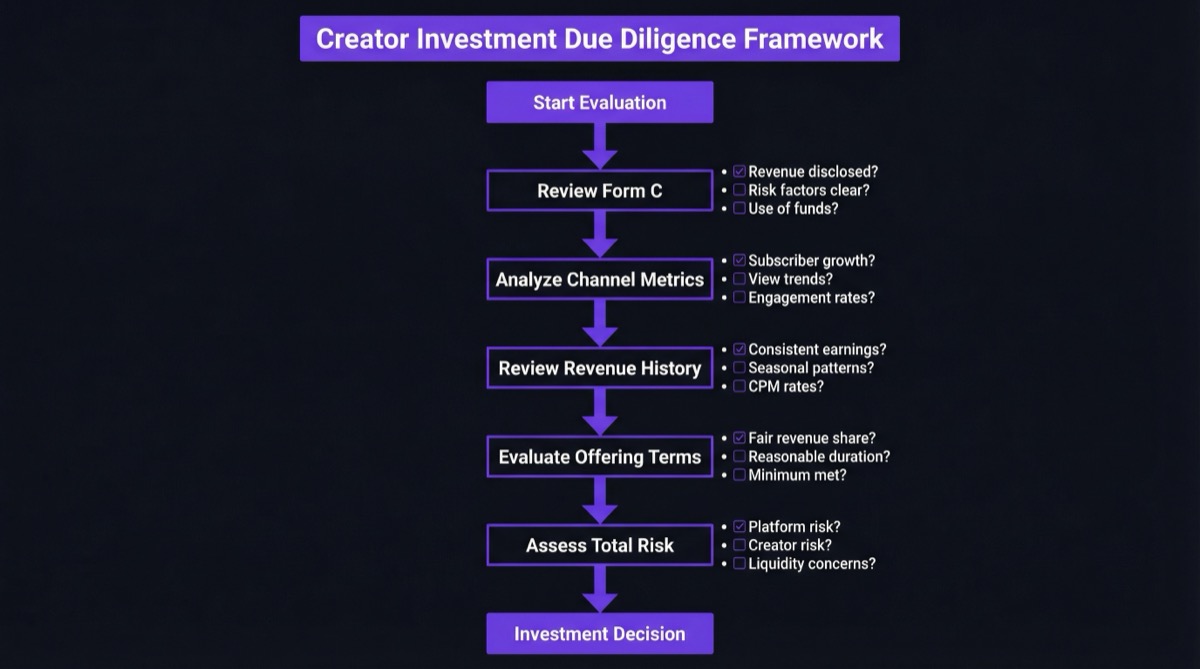
Step 1: Start with the Form C
The Form C is the cornerstone of your due diligence. It is the formal disclosure document required by the SEC for every Regulation Crowdfunding offering. Every Creator raising capital through GigaStar Market must file a Form C, and every Investor should read it before investing.
The Form C is not marketing material. It is a regulatory filing that provides a standardized, comprehensive overview of the offering. Here are the key sections to focus on.
Business Description
This section describes the Creator, their channel, their content niche, and their business. It should give you a clear picture of who the Creator is, what kind of content they produce, and how their channel operates. Look for specifics. A vague business description with no concrete details about the channel or content strategy warrants caution.
Offering Terms
This section lays out the financial structure of the offering: the price per CRT, the total number of CRTs being offered, the minimum and maximum raise amounts, the revenue-sharing percentage, and the duration of the revenue-sharing agreement. These are the terms that will govern your investment for its entire lifespan. Make sure you understand every one of them.
Risk Factors
This is arguably the most important section in the Form C. The risk factors section identifies specific scenarios that could result in reduced distributions or total loss of your investment. Creators are required to disclose material risks, and you should read every single risk factor listed. Do not assume that the risks are boilerplate or that they apply only to other Investors. Each risk is a scenario that could directly affect the value of your investment.
Financial Statements
The financial statements provide a quantitative picture of the Creator's revenue history, expenses, and overall financial condition. Depending on the size of the raise, financial statements may be audited, reviewed, or compiled by a third-party accountant. Understand the level of assurance provided, and review the revenue figures carefully for trends and consistency.
Use of Proceeds
This section describes how the Creator intends to use the capital raised. Growth-oriented uses — such as hiring production staff, purchasing equipment, or expanding content output — may suggest the Creator is investing in their channel's future. Uses that do not directly support channel growth or content production may warrant additional scrutiny.
For a detailed walkthrough of every Form C section, see How to Read a CRT Offering's Form C.
Step 2: Analyze Channel Metrics
After reviewing the Form C, turn your attention to the Creator's channel metrics. These quantitative data points help you understand the health and trajectory of the Creator's YouTube channel.
Subscriber Count and Growth Trend
Subscriber count is the most visible metric for any YouTube channel, but it is not the most informative. A channel with 2 million subscribers that has stopped growing may generate less revenue than a channel with 500,000 subscribers that is growing steadily. What matters more than the absolute number is the trend: is the subscriber base growing, stable, or declining?
Look at subscriber growth over multiple time periods — the last 3 months, 6 months, and 12 months. A consistent upward trend suggests the Creator is attracting new viewers. A sharp decline or prolonged plateau may indicate that the channel's content is losing appeal or that the niche is becoming saturated.
Monthly Views
Monthly views are a more direct indicator of revenue potential than subscribers because YouTube ad revenue is generated per view, not per subscriber. A subscriber who does not watch a Creator's videos generates no ad revenue. Look at total monthly views over the past 12 to 24 months and assess the trend.
Consistency matters more than peaks. A channel that generates 5 million views every month is, from a revenue perspective, more predictable than a channel that generates 20 million views one month and 1 million the next. Spiky view counts may indicate that the channel depends on viral hits rather than a stable, engaged audience.
Watch Time and Audience Retention
Watch time measures the total minutes viewers spend watching a Creator's content. Audience retention measures what percentage of a video viewers watch before leaving. Both metrics directly affect ad revenue because longer watch times mean more ad impressions.
A channel with high audience retention — viewers consistently watching 60% or more of each video — is likely providing content that resonates with its audience. Low retention rates may indicate that viewers are clicking on videos but quickly losing interest, which reduces ad revenue per view.
Engagement Rates
Engagement metrics include likes, comments, shares, and other viewer interactions relative to total views. High engagement suggests an active, loyal audience. Low engagement on videos with high view counts could indicate that the Creator is relying on clickbait or algorithmic recommendations rather than genuine audience interest.
For a comprehensive breakdown of each metric and what it tells you, see Key Channel Metrics for Evaluating Creators.
Step 3: Evaluate Revenue History
Channel metrics tell you about audience behavior. Revenue history tells you about financial performance. Both are essential components of your evaluation.
Revenue Trends Over 12 to 24 Months
Request or review the Creator's revenue data for at least the past 12 months, and ideally 24 months. The Form C's financial statements provide this information. Look at the overall trajectory: is revenue growing, stable, or declining?
A channel with steadily growing revenue over 24 months demonstrates a track record of sustained audience interest and monetization. A channel with flat revenue may still be a reasonable investment if the consistency is strong, but it sets different expectations than a growth-oriented channel. A channel with declining revenue over multiple quarters deserves careful scrutiny — declining revenue is a risk factor that could continue after you invest.
Revenue Per View Trends
Revenue per view (sometimes expressed as RPM, or revenue per mille/thousand views) tells you how effectively the Creator is monetizing their audience. If revenue per view is declining even while total views are increasing, it could indicate changes in the Creator's content mix, audience geography, or YouTube's ad market that are working against monetization.
CPM Analysis
CPM (cost per mille) is the amount advertisers pay per thousand ad impressions. CPM rates vary significantly by content niche. Finance, business, and technology channels tend to command higher CPMs because advertisers in those sectors are willing to pay more to reach their target audiences. Entertainment, gaming, and vlogging channels typically have lower CPMs.
Understanding the CPM range typical for a Creator's niche helps you assess whether their revenue per view is in line with expectations, above average, or below average.
Seasonal Patterns
YouTube ad revenue is seasonal. Q4 (October through December) is consistently the highest-revenue quarter for most Creators because advertisers increase spending during the holiday season. Q1 (January through March) is typically the weakest quarter as advertisers reduce budgets after the holiday push.
When evaluating revenue history, account for these seasonal patterns. A decline from December to January is expected. A decline from June to July is less expected and may warrant investigation.
Consistency Versus Volatility
Some Creators generate remarkably consistent revenue month over month. Others have high volatility, with significant swings between months. Higher consistency makes it easier to form reasonable expectations about future distributions, while higher volatility introduces more uncertainty. Neither is inherently good or bad, but you should understand which pattern applies to the Creator you are evaluating and how it aligns with your risk tolerance.
Step 4: Understand the Offering Terms
The offering terms define the financial relationship between you and the Creator for the duration of the revenue-sharing agreement. Each term has direct implications for the potential value of your investment.
Revenue-Sharing Percentage
This is the percentage of the Creator's YouTube revenue that will be distributed to CRT holders collectively. A higher percentage means a larger share of revenue flows to Investors, but it also means the Creator retains less, which could affect their motivation or ability to reinvest in their channel. Evaluate the percentage in the context of the Creator's total revenue.
Duration of the Agreement
The revenue-sharing period defines how long distributions will continue. A longer duration means more months of potential distributions, but it also means more time during which the Creator's channel performance could change — positively or negatively. Consider what the channel and content landscape might look like multiple years from now.
What Revenue Is Included
Not all Creator revenue may be subject to the revenue-sharing agreement. Typically, the agreement covers YouTube AdSense revenue. Sponsorship deals, merchandise sales, membership revenue, and other income streams may or may not be included. The Form C specifies exactly what revenue is covered. Read this definition carefully.
Minimum and Maximum Raise Amounts
The minimum raise amount is the threshold that must be met for the offering to close. If the minimum is not reached, all investments are returned. The maximum raise is the most the Creator can raise in the offering. Consider whether the raise amount is reasonable relative to the Creator's revenue — an outsized raise relative to revenue could dilute the per-CRT value of distributions.
Price Per CRT and Total CRTs Offered
The price per CRT and the total number of CRTs determine the overall economics of the offering. Divide the total raise amount by the number of CRTs to understand the per-unit cost, and consider how the revenue-sharing percentage will be divided across all outstanding CRTs.
Step 5: Assess Content and Audience Quality
Numbers tell part of the story. The qualitative aspects of a Creator's content and audience tell the rest.
Content Niche Durability
Some content niches have lasting demand. Educational content, how-to guides, product reviews, and evergreen topics tend to generate views over long periods. Trend-dependent content — videos about current events, viral challenges, or rapidly evolving cultural moments — may generate views in the short term but decay quickly. Consider whether the Creator's content niche is likely to sustain audience interest over the full revenue-sharing period.
Audience Demographics
The demographics of a Creator's audience directly affect revenue. Advertisers pay different CPMs to reach different audiences. Content that attracts viewers in higher-income countries (United States, United Kingdom, Canada, Australia) typically generates higher ad revenue per view than content with a predominantly global south audience. Age, gender, and interest demographics also affect advertiser demand.
Geographic Distribution
Related to demographics, the geographic distribution of a Creator's audience has a significant impact on CPMs. A channel where 70% of views come from the United States will typically generate more revenue per view than a channel where 70% of views come from regions with lower advertiser demand. This information may be available in the Form C or on the offering page.
Content Diversification
A Creator who produces content across multiple subtopics within their niche is less vulnerable to a single topic losing popularity. A technology reviewer who covers smartphones, laptops, smart home devices, and software has a broader content base than one who covers only a single product category. Greater content diversification provides some insulation against shifts in viewer interest.
Creator's Content Pipeline and Plans
What does the Creator plan to do with the capital raised? The use of proceeds section of the Form C addresses this. A Creator who plans to hire additional editors, upgrade production equipment, or expand into new content formats is investing in their channel's capacity to grow. Consider whether the Creator's stated plans are realistic and likely to support continued or growing revenue generation.
Step 6: Evaluate Creator-Specific Risks
Beyond the general risks that apply to all CRT investments, each Creator presents specific risk factors that require individual assessment.
Solo Creator Versus Team
A Creator who is the sole person responsible for all content creation, editing, and production represents a concentration of risk. If that individual experiences health issues, burnout, or personal circumstances that prevent content production, the channel's output — and revenue — could drop significantly. A Creator with a team (editors, writers, producers) has built-in redundancy that may sustain output even if the primary Creator needs to step back temporarily.
Content Style Sustainability
Some content styles are physically or emotionally demanding. Creators who produce high-energy daily content, extreme challenge videos, or content that requires significant travel may face sustainability challenges over a multi-year revenue-sharing period. Consider whether the Creator's content style can be maintained over the duration of the agreement.
Competitive Landscape
YouTube niches can become crowded. A Creator who currently dominates a small niche may face increased competition as other Creators enter the space. Evaluate how defensible the Creator's position is. Strong brand identity, loyal audience, and unique expertise provide competitive advantages that are harder for newcomers to replicate.
Platform Dependency
All CRT revenue depends on YouTube. If YouTube changes its monetization policies, ad revenue split, content guidelines, or recommendation algorithms, the Creator's revenue could be materially affected. While this risk applies to all CRT offerings, some Creators may be more vulnerable than others — for example, Creators whose content frequently borders on YouTube's content policy boundaries face higher demonetization risk.
Reputational Considerations
A Creator's personal reputation affects their channel. Controversial statements, legal issues, or public relations problems can lead to advertiser boycotts, demonetization, or audience loss. While it is impossible to predict reputational events, consider the Creator's public track record and how they have handled challenges in the past.
Red Flags to Watch For
Certain patterns should prompt additional scrutiny or reconsideration of an investment. These red flags do not necessarily mean an offering is a poor investment, but they warrant careful investigation.
Declining Metrics Without Explanation
If a Creator's views, subscribers, or revenue have been declining over recent months and the Form C or offering materials do not address this trend, that is a concern. Transparency about challenges is a sign of a responsible issuer. Silence about obvious declines is a red flag.
Inconsistent Upload Schedule
Revenue on YouTube is closely tied to content production. A Creator with an erratic upload schedule — long periods of inactivity followed by bursts of content — may struggle to maintain consistent revenue. Look at the upload history over the past 12 months and assess whether the pace is sustainable.
Heavy Reliance on Single Video Types
A Creator whose revenue is concentrated in one type of video or a single series faces higher risk if that format loses popularity. Diversified content strategies spread this risk across multiple video types and topics.
Unrealistic Projections in Materials
While Form C filings must be factual, supplementary materials on an offering page may paint an optimistic picture. Be wary of materials that suggest specific distribution amounts, imply guaranteed outcomes, or project aggressive growth without acknowledging the uncertainty involved. Responsible Creators and platforms present possibilities alongside risks.
Revenue Concentration from Few Videos
If a significant portion of a Creator's historical revenue came from a small number of viral videos, that revenue pattern may not be repeatable. Sustainable revenue typically comes from a broad catalog of content that generates consistent views over time, not from occasional viral hits.
Comparing Multiple Offerings
When multiple Creator offerings are available simultaneously, you have the opportunity to compare and select based on your own investment criteria and risk tolerance.
Build a Comparison Framework
Consider evaluating offerings across these dimensions:
- Revenue consistency: Which Creator has the most consistent monthly revenue over the past 12 to 24 months?
- Channel trajectory: Which Creator's channel is on the most positive trajectory in terms of views, subscribers, and engagement?
- Offering terms: Which offering provides terms (revenue-sharing percentage, duration) that align with your goals?
- Risk profile: Which Creator presents the most manageable risk profile given your tolerance for uncertainty?
- Content niche: Which Creator operates in a niche with durable audience demand and favorable CPMs?
Not All Offerings Are Equal
It may be tempting to invest in the Creator with the largest subscriber count or the highest historical revenue. But a smaller Creator with more consistent performance, better engagement, and favorable offering terms may present a more compelling risk-adjusted opportunity. Evaluate the complete picture rather than optimizing for any single metric.
Diversification Across Offerings
If you are considering investing in multiple CRT offerings, think about diversification. Spreading your investment across Creators in different niches, with different audience sizes, and at different stages of channel growth may help reduce the impact of any single Creator's underperformance. Diversification does not eliminate risk, but it can reduce concentration risk.
Making Your Decision
After completing your evaluation, you face the investment decision. Here are principles to keep in mind.
No Perfect Offering Exists
Every Creator offering has strengths and weaknesses. A Creator with excellent metrics may have less favorable offering terms. A Creator with strong terms may operate in a declining niche. Your evaluation process is designed to help you understand the trade-offs, not to find a perfect investment that does not exist.
Balance Risk and Opportunity
CRT investments involve significant risk, including the potential total loss of your invested capital. At the same time, they provide exposure to an alternative asset class tied to the growing Creator Economy. Your decision should reflect an honest assessment of both the risks and the potential opportunity, without overweighting either side.
Only Invest What You Can Afford to Lose
This principle applies to all CRT investments, regardless of how favorable your evaluation is. The Creator Economy is dynamic and unpredictable. A Creator who appears strong today may face challenges tomorrow. Only commit capital that you are genuinely prepared to lose entirely without affecting your financial stability.
Diversification Reduces Single-Creator Risk
If you invest your entire CRT allocation in a single Creator and that Creator's channel declines, your entire CRT investment is affected. Spreading your allocation across multiple Creators and niches reduces this concentration risk. Diversification is not a guarantee against loss, but it is a sound risk management principle.
Revisit Your Analysis
CRT investments span extended periods. The Creator whose offering you evaluated today may look very different in 12 or 18 months. While you cannot change the terms of an existing investment, staying informed about the Creator's channel performance helps you make better decisions about future investments and, once the Secondary Market launches, potential portfolio adjustments.
Key Takeaways
- Every Creator offering is unique and requires individual evaluation. Do not assume that one offering's characteristics apply to another.
- The Form C is your primary due diligence tool. Read it thoroughly, especially the risk factors and financial statements.
- Channel metrics including views, subscribers, engagement, and watch time provide quantitative insight into a Creator's channel health.
- Revenue history over 12 to 24 months reveals trends, consistency, and seasonal patterns that inform your expectations.
- Offering terms define the financial structure of your investment. Understand the revenue-sharing percentage, duration, and what revenue is included.
- Content quality and audience demographics affect long-term revenue potential. Durable niches and favorable geographic distribution support higher CPMs.
- Creator-specific risks including solo-Creator dependency, content sustainability, and competitive dynamics deserve individual assessment.
- Red flags such as declining metrics, inconsistent uploads, and revenue concentration from few videos warrant additional scrutiny.
- Comparing offerings across multiple dimensions helps you select investments that align with your risk tolerance and goals.
- Only invest what you can afford to lose entirely, and consider diversifying across multiple offerings to reduce concentration risk.
This content is for educational purposes only and does not constitute investment advice. CRT investments involve significant risk, including potential total loss of invested capital. Past performance does not predict future results.
Frequently Asked Questions
What should I look for when evaluating a CRT offering?
Start with the Form C disclosure document — it is the SEC-required filing that contains all material information about the offering. Read the business description to understand the Creator and their channel. Review the offering terms to understand the revenue-sharing percentage, duration, and pricing. Examine the financial statements for revenue history and trends. Most importantly, read every risk factor listed. After reviewing the Form C, analyze the Creator's publicly available channel metrics, including monthly views, subscriber growth, engagement rates, and upload consistency. Consider the Creator's content niche, audience demographics, and competitive position. No single factor should drive your decision — evaluate the complete picture.
How do I read and understand a Form C?
The Form C is organized into several key sections. The business description explains who the Creator is and what their channel does. The offering terms section details the price per CRT, the revenue-sharing percentage, the duration, and the raise amount. The risk factors section identifies specific scenarios that could negatively affect your investment — do not skip this section. The financial statements provide historical revenue and expense data. The use of proceeds section explains how the Creator plans to deploy the capital raised. For a detailed section-by-section guide, see How to Read a CRT Offering's Form C.
What channel metrics matter most for CRT investing?
Monthly view consistency is often more informative than subscriber count because YouTube ad revenue is generated per view, not per subscriber. Look at total monthly views over 12 or more months and assess whether the trend is stable, growing, or declining. Audience retention and watch time are also critical because longer viewing sessions generate more ad impressions and more revenue. CPM rates matter because they determine how much revenue each view generates, and these vary significantly by content niche and audience geography. Engagement metrics (likes, comments, shares relative to views) indicate how actively involved the audience is. For a complete breakdown, see Key Channel Metrics for Evaluating Creators.
What are red flags in a Creator offering?
Significant red flags include declining views, subscribers, or revenue over recent months with no acknowledgment or explanation in the offering materials. An inconsistent upload schedule suggests the Creator may struggle to maintain the content output needed to sustain revenue. Heavy reliance on a single video type or topic creates concentration risk if that format loses popularity. Revenue that is concentrated in a small number of viral videos may not be repeatable. Materials that imply specific distribution amounts or guaranteed outcomes should raise immediate concerns, as no distribution amount is ever certain. Discrepancies between publicly available channel data and information presented in the offering materials are also a serious concern.
How do I compare multiple CRT offerings to decide where to invest?
Develop a structured framework that evaluates each offering across several dimensions. Compare revenue consistency — which Creator has generated the most stable revenue over time? Assess channel trajectory — which Creator's metrics are trending in the most positive direction? Review offering terms — which revenue-sharing percentage and duration best align with your goals? Evaluate risk profiles — which Creator presents risks you are most comfortable with given your tolerance? Consider content niches — which Creator operates in a niche with durable demand and favorable advertiser rates? Remember that no single metric determines which offering is better, and the best choice depends on your individual financial situation, risk tolerance, and investment goals. Diversifying across multiple offerings rather than concentrating in one Creator can help manage single-Creator risk.
Sources
- U.S. Securities and Exchange Commission. "Regulation Crowdfunding: A Small Entity Compliance Guide for Issuers." SEC.gov. https://www.sec.gov/resources-small-businesses/small-business-compliance-guides/regulation-crowdfunding-small-entity-compliance-guide-issuers
- FINRA. "Crowdfunding: What Investors Should Know." FINRA.org. https://www.finra.org/investors/insights/crowdfunding/investors-should-know
- YouTube Help. "YouTube Partner Earnings Overview." Google Support. https://support.google.com/youtube/answer/72902?hl=en
- U.S. Securities and Exchange Commission. "Regulation Crowdfunding: Guidance for Issuers." SEC.gov. https://www.sec.gov/resources-small-businesses/regulation-crowdfunding-guidance-issuers