Understanding Revenue-Based Securities
What are revenue-based securities and how do they work?
Revenue-based securities are financial instruments that provide Investors with contractual rights to receive a share of a company's or Creator's revenue. They differ from equity and debt by tying distributions to actual revenue rather than earnings or fixed payments.
Educational Content: This content is for educational purposes only and does not constitute investment advice. All investments involve risk, including potential loss of principal. See full disclosures.
What Are Revenue-Based Securities?
Revenue-based securities are financial instruments that give Investors the contractual right to receive a share of revenue generated by a business, project, or individual. Unlike equity securities (stocks), which represent ownership in a company, and unlike debt securities (bonds), which represent a loan with fixed repayment terms, revenue-based securities tie Investor distributions directly to actual revenue.
The core concept is straightforward: an entity generates revenue, and a defined portion of that revenue flows to Investors who hold the revenue-based security. The amount an Investor receives in any given period depends on how much revenue was actually generated during that period. If revenue is higher, distributions are higher. If revenue declines, distributions decline proportionally.
This structure has gained attention as part of a broader category of alternative investments that offer exposure to revenue streams outside of traditional public equity and fixed-income markets. Revenue-based securities have been applied across various industries, from small business lending alternatives to technology startups to, most recently, the Creator Economy.
What makes revenue-based securities distinct is the directness of the link between the underlying economic activity and the Investor's experience. There is no intermediary calculation of net income or margins, no board decision on whether to declare a payment, and no fixed schedule of principal repayment. The security's performance is tied to revenue, which is typically a more transparent and more readily observable metric than earnings.
How Revenue-Based Securities Differ from Traditional Securities
Understanding revenue-based securities requires comparing them against the three most common categories of traditional securities: equity, debt, and real estate investment trusts (REITs).
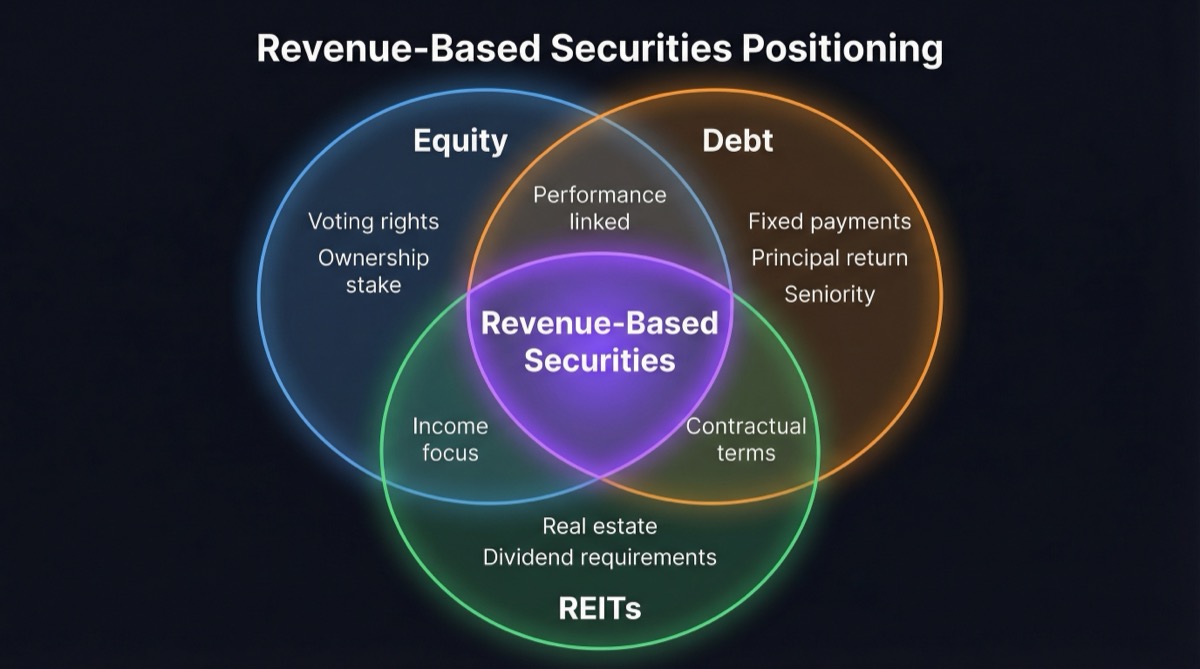
Versus Equity (Stocks)
When you purchase shares of stock in a company, you acquire an ownership stake. That ownership typically comes with voting rights, a claim on the company's residual assets in the event of liquidation, and the potential to receive payments if the board of directors declares them. The value of your investment is tied to the company's overall valuation, which reflects the market's assessment of future earnings, growth potential, and many other factors.
Revenue-based securities are fundamentally different:
- No ownership stake: Holding a revenue-based security does not make you a partial owner of the entity.
- No voting rights: You have no say in management decisions, strategy, or governance.
- Revenue, not earnings: Distributions are calculated from revenue, not from net income or earnings per share. A company or Creator can have high revenue but low or negative net income, and distributions would still flow based on the revenue figure.
- Contractual, not discretionary: Distributions from revenue-based securities are governed by the terms of the offering agreement, not by a board vote.
Versus Debt (Bonds)
Bonds and other debt securities represent a loan. The issuer borrows money from the Investor and agrees to pay it back with interest on a defined schedule. The Investor receives fixed, scheduled payments regardless of how well the issuer's business performs (assuming the issuer does not default).
Revenue-based securities differ from debt in several important ways:
- No fixed payments: There is no stated interest rate or fixed coupon. Distributions vary based on actual revenue.
- No principal repayment obligation: Unlike a bond, there is no promise to return the original investment amount at a specific maturity date. The Investor receives only their share of revenue as it is generated.
- Variable distributions: In periods of strong revenue, distributions may exceed what a comparable bond would pay. In periods of weak revenue, distributions may be significantly lower -- or could be zero.
- No maturity date in the traditional sense: While revenue-based securities may have a defined duration (the period during which revenue sharing occurs), this is not the same as a bond's maturity date. There is no lump-sum return of principal at the end.
Versus REITs
Real estate investment trusts share some conceptual similarities with revenue-based securities in that both involve distributing income from an underlying asset. REITs pool Investor capital to purchase, manage, and distribute income from real estate properties. The revenue source is typically rental income and property sales.
The differences are meaningful, however:
- Underlying asset: REITs are backed by physical real estate. Revenue-based securities can be backed by any revenue stream, including digital content revenue, software subscriptions, or service fees.
- Diversification structure: Most REITs hold portfolios of multiple properties. A single revenue-based security is typically tied to one specific revenue source.
- Liquidity: Publicly traded REITs are listed on stock exchanges and can be bought and sold at any time during market hours. Revenue-based securities, particularly those offered under Reg CF, are generally illiquid and subject to resale restrictions.
The Legal Structure
Revenue-based securities are, first and foremost, securities under federal law. This means they are subject to the same foundational regulatory requirements as stocks, bonds, and other investment instruments.
Contractual Rights
The legal basis for a revenue-based security is a contract between the issuer and the Investor. This contract specifies:
- The percentage of revenue to be shared
- The duration of the revenue-sharing period
- The definition of "revenue" for the purpose of calculating distributions (this is critical, as different definitions can produce very different outcomes)
- The frequency of distributions (for example, monthly)
- Any conditions, limitations, or exceptions that apply
- The rights and obligations of both parties
These terms are documented in the offering materials, specifically the Form C filing with the SEC for offerings conducted under Regulation Crowdfunding.
SEC Registration Requirements
Revenue-based securities offered to the public must comply with federal securities registration requirements or qualify for an exemption. The most common exemption for offerings to non-accredited Investors is Regulation Crowdfunding (Reg CF), which allows companies to raise up to $5 million in a 12-month period through SEC-registered funding portals.
The Form C filing is the central disclosure document. It must include the offering terms, risk factors, financial statements, information about the issuer's business, and the planned use of proceeds. This filing is publicly available on the SEC's EDGAR database and on the funding portal hosting the offering.
Investor Protections
Because revenue-based securities are regulated securities, Investors benefit from the protections built into the applicable regulatory framework. Under Reg CF, these include investment limits based on income and net worth, mandatory disclosures, cancellation rights, and annual reporting obligations by the issuer. For a detailed discussion of these protections, see SEC Regulation Crowdfunding: What Investors Need to Know.
CRTs as Revenue-Based Securities
Channel Revenue Tokens (CRTs) offered through GigaStar Market are a specific implementation of the revenue-based security model, applied to the Creator Economy.
How CRTs Work
Each CRT represents the contractual right to receive a specified share of a YouTube Creator's potential future revenue for a defined period. The structure works as follows:
- A Creator applies to raise capital through GigaStar Market and, if approved, files a Form C with the SEC detailing the offering terms.
- Investors purchase CRTs during the offering period through GigaStar Market, the SEC-registered funding portal.
- After the offering closes, the revenue-sharing period begins. YouTube pays the Creator their share of ad revenue (and other applicable revenue streams as specified in the offering).
- The Creator reports revenue to GigaStar, which calculates the distributions owed to CRT holders based on the terms specified in the Form C.
- Distributions are made to CRT holders on a monthly basis, proportional to the number of CRTs each Investor holds.
What Makes CRTs Distinctive
CRTs apply the revenue-based security model to a specific and relatively new underlying asset: YouTube channel revenue. This is distinctive for several reasons:
- Observable revenue source: YouTube revenue is generated through well-understood monetization mechanisms, primarily advertising. While the amount of revenue a Creator generates can vary significantly, the mechanism through which it is generated is transparent.
- Creator-specific: Each CRT offering is tied to a single Creator's channel. This means the performance of your investment is directly linked to that specific Creator's ability to generate revenue over the duration of the revenue-sharing period.
- Regulated offering: CRTs are offered under Reg CF through an SEC-registered funding portal, providing the disclosure and compliance framework described above.
Regulatory Framework
The regulatory framework governing revenue-based securities like CRTs is the same framework that governs other securities offered under Regulation Crowdfunding.
SEC Regulation Crowdfunding
All CRT offerings are conducted under Reg CF. This means:
- Offerings must be conducted through an SEC-registered, FINRA-member funding portal (GigaStar Market).
- The issuer must file Form C with the SEC before launching an offering.
- Investor investment limits apply based on annual income and net worth.
- Investors have cancellation rights up to 48 hours before the offering deadline.
- The issuer must file annual reports after a successful raise.
- Securities are subject to a 12-month resale restriction.
Disclosure Requirements
The Form C for each CRT offering must include:
- The specific revenue-sharing percentage and duration
- A clear definition of the revenue subject to sharing
- Risk factors specific to the Creator, the platform, and the investment structure
- Financial statements appropriate to the size of the offering
- Information about how distributions are calculated and paid
These disclosures give Investors the information needed to evaluate the offering and understand the terms of the revenue-based security they are purchasing.
Secondary Trading
After the 12-month holding period required for Reg CF securities, CRTs may be eligible for resale through the Alternative Trading System operated by GigaStar Securities, a FINRA-member broker-dealer, launching March 16, 2026. For details on how secondary trading works, see SEC Regulation Crowdfunding: What Investors Need to Know.
Advantages and Limitations for Investors
Revenue-based securities offer a distinct set of characteristics that may appeal to certain Investors. Understanding both the potential advantages and the real limitations is essential before investing.
Potential Advantages
- Access to the Creator Economy: Revenue-based securities like CRTs provide a way for Investors to participate in the economic activity of the Creator Economy -- a large and growing sector driven by digital content consumption. Without instruments like CRTs, individual Investors would have limited avenues to gain direct exposure to Creator revenue streams.
- Potential portfolio diversification: Because revenue-based securities are tied to revenue streams that may not correlate closely with traditional stock and bond markets, they could offer diversification characteristics. However, diversification does not eliminate risk, and the limited history of this asset class makes it difficult to assess correlation patterns with confidence.
- Regulated framework: CRTs are offered under Reg CF through an SEC-registered funding portal. This provides mandatory disclosures, investment limits, and other Investor protections that are absent from unregulated investment opportunities.
- Transparent distribution basis: Distributions are tied to revenue, which is typically a more straightforward and observable metric than net income. Investors can track distribution patterns over time relative to the Creator's publicly visible channel activity.
Limitations and Risks
- Revenue variability: Distributions from revenue-based securities depend entirely on actual revenue generated. Creator revenue can fluctuate significantly based on content output, audience engagement, advertiser demand, YouTube platform changes, and other factors outside the Investor's control.
- Illiquidity: CRTs are subject to a 12-month resale restriction under Reg CF rules. Even after that period, liquidity depends on the availability of buyers on the Secondary Market. There is no assurance that you will be able to sell your CRTs at a price you find acceptable, or at all.
- Potential for total loss: If a Creator's revenue declines to zero -- whether due to inactivity, channel termination, platform policy changes, or other reasons -- distributions would cease entirely. Investors could lose their entire invested capital.
- Limited track record: Revenue-based securities tied to Creator revenue are a relatively new category of investment. There is limited historical data to draw on when evaluating long-term performance expectations, default rates, or recovery patterns.
- No ownership or control: Investors have no ownership stake in the Creator's channel, no voting rights, and no ability to influence the Creator's content strategy, business decisions, or platform behavior.
- Platform dependency: CRT revenue is generated through YouTube. Changes to YouTube's monetization policies, revenue-sharing terms, content policies, or platform algorithms could materially affect Creator revenue and, consequently, CRT distributions.
Key Takeaways
- Revenue-based securities tie distributions to actual revenue, distinguishing them from equity (ownership), debt (fixed payments), and other security types.
- CRTs are a specific type of revenue-based security offered under SEC Regulation Crowdfunding through GigaStar Market, an SEC-registered funding portal.
- The legal foundation is contractual: terms are defined in the Form C, including the revenue percentage, duration, distribution schedule, and risk factors.
- Potential advantages include access to the Creator Economy, a regulated offering framework, and a transparent distribution basis.
- Significant limitations include revenue variability, illiquidity, potential total loss, limited historical track record, and no ownership or control over the underlying revenue source.
- Regulatory protections under Reg CF -- including mandatory disclosures, investment limits, cancellation rights, and annual reporting -- apply to all CRT offerings, but do not eliminate investment risk.
Before investing in any revenue-based security, read the offering documents carefully, understand the specific terms and risk factors, and consider how the investment fits within your overall financial situation. If you have questions about a specific CRT offering, review the Form C on GigaStar Market or contact info@gigastar.io.
This content is for educational purposes only and does not constitute investment advice. CRT investments involve significant risk, including potential total loss of invested capital. Past performance does not predict future results.