Understanding Bid-Ask Spreads on CRTs
What is a bid-ask spread on CRTs?
The bid-ask spread is the difference between the highest price a buyer will pay (bid) and the lowest price a seller will accept (ask). A wider spread typically indicates lower liquidity.
Educational Content: This content is for educational purposes only and does not constitute investment advice. All investments involve risk, including potential loss of principal. See full disclosures.
The Price Gap That Every CRT Trader Should Understand
If you have ever looked at a stock quote and noticed two different prices — one for buying and one for selling — you have already encountered the bid-ask spread. On the GigaStar Secondary Market, launching March 16, 2026, the bid-ask spread will be one of the most important numbers to understand before placing any trade on Channel Revenue Tokens (CRTs).
The spread tells you something essential about the current state of the market for a given CRT: how close buyers and sellers are to agreeing on price, and how much it may cost you to execute a trade right now. This article breaks down what the spread is, how it works, and what it means for your trading decisions.
What Is a Bid-Ask Spread?
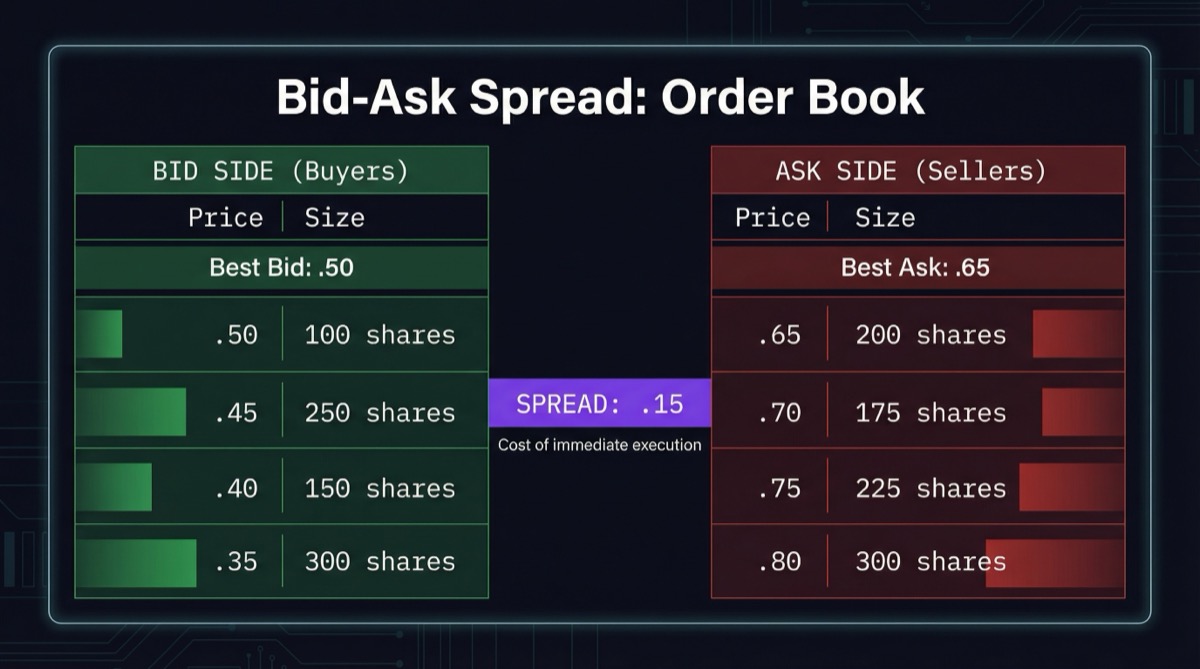
Every active market has two sides: buyers and sellers. The bid price is the highest price any buyer is currently willing to pay for a CRT. The ask price (also called the offer price) is the lowest price any seller is currently willing to accept. The bid-ask spread is the difference between these two numbers.
For example:
- Bid: $9.50 (the most a buyer will pay right now)
- Ask: $10.25 (the least a seller will accept right now)
- Spread: $0.75
The spread exists because buyers naturally want to pay less and sellers naturally want to receive more. The gap between them represents the range where no trade is currently happening — buyers and sellers have not yet agreed on a price.
How the Spread Works in Practice
Let us walk through a concrete example on the GigaStar Secondary Market.
Suppose you are interested in a CRT for a popular Creator. You open the order book and see:
Buy Orders (Bids)
| Price | Quantity |
|---|---|
| $10.00 | 80 |
| $9.75 | 120 |
| $9.50 | 50 |
Sell Orders (Asks)
| Price | Quantity |
|---|---|
| $10.50 | 60 |
| $10.75 | 40 |
| $11.00 | 90 |
The bid-ask spread here is $0.50 ($10.50 minus $10.00).
If you want to buy immediately using a market order, you would pay $10.50 per CRT (the lowest ask). If you want to sell immediately using a market order, you would receive $10.00 per CRT (the highest bid). The $0.50 difference is the cost of immediacy — the price you pay for executing right now rather than waiting.
If you use a limit order, you could place a buy order at $10.25 — right in the middle of the spread. Your order would sit on the book, and if a seller later decides they are willing to accept $10.25, the trade would execute there. This approach can save you money, but it requires patience and carries the risk that no seller meets your price.
Why Spreads Matter for CRT Trading
The bid-ask spread matters for three practical reasons.
First, the spread is an implicit trading cost. Beyond any explicit fees the platform charges, the spread represents an additional cost every time you trade. If you buy a CRT at the ask price of $10.50 and later sell at a bid price of $10.00, you have already absorbed a $0.50 per-CRT cost just from the spread, before accounting for any changes in the CRT's market value or transaction fees.
Second, the spread signals market conditions. A tight spread (a small gap between bid and ask) generally indicates that a CRT has active trading interest and that buyers and sellers are close to agreement on value. A wide spread indicates the opposite: fewer participants, less consensus on fair value, and potentially higher costs to trade. Monitoring spreads gives you a real-time indicator of how liquid a particular CRT is at any given moment.
Third, the spread affects your order strategy. Whether you choose a market order or a limit order should depend, in part, on the current spread. A narrow spread makes market orders more reasonable because the cost of immediacy is low. A wide spread tips the balance toward limit orders, where you can target a specific price within the gap and potentially achieve better execution.
Factors That Affect the Spread
Not all CRTs on the Secondary Market will have the same spread. Several factors influence how wide or narrow the spread will be for a particular token.
Liquidity and Number of Participants
The single biggest factor affecting the spread is liquidity — the number of active buyers and sellers for a given CRT. More participants generally means more competition among buyers (pushing bids higher) and more competition among sellers (pushing asks lower), which narrows the spread. Fewer participants means less competition, wider gaps, and higher trading costs.
Trading Volume
CRTs that trade more frequently tend to have tighter spreads. Regular trading activity creates a feedback loop: more trades generate more price information, which gives participants more confidence in pricing, which encourages more participation. Conversely, CRTs that rarely trade may have stale orders on the book and wide spreads that do not reflect current conditions.
Creator Popularity and Channel Performance
CRTs linked to well-known Creators with strong and growing YouTube channels are likely to attract more Investor interest on both sides of the market. This increased interest tends to produce narrower spreads. CRTs for less prominent Creators or Creators with declining channel metrics may see less interest and wider spreads.
Market Conditions and Sentiment
Broader factors can also influence spreads. During periods of heightened uncertainty — whether about the Creator Economy in general, a specific Creator's trajectory, or external economic conditions — participants may pull back their orders or widen their pricing to account for increased risk. This widens spreads across the board.
Time of Day and Market Activity
During the most active trading periods, spreads may be tighter because more Investors are placing and adjusting orders. During quieter periods, the order book may thin out and spreads may widen.
How to Navigate Wider Spreads
Wider spreads are a reality of newer and smaller markets. Here are practical approaches for trading effectively when spreads are not as tight as you might prefer.
Use limit orders to trade within the spread. Rather than accepting the current bid or ask, place a limit order at a price between the two. If the spread is $9.50 to $10.50, a limit buy at $10.00 or a limit sell at $10.00 places you in the middle. You may attract a counterparty willing to meet in that range, and you avoid paying the full cost of the spread.
Check the order book before every trade. Do not trade blindly. Before placing any order, review the current bids, asks, volume at each price level, and the overall spread. This information should directly inform your order type and price.
Be patient with limit orders. In a wide-spread market, limit orders placed inside the spread may take time to fill. That patience can be worthwhile if it means a meaningfully better execution price.
Avoid large market orders in wide-spread markets. A market order in a thin order book does not just hit the top bid or ask — it can eat through multiple price levels, resulting in an average price far worse than the displayed spread suggests. If you need to trade a larger quantity, consider breaking it into smaller limit orders.
Monitor spread changes over time. Spreads are not static. They move throughout the trading day and change as market conditions evolve. A CRT with a wide spread today might tighten tomorrow if new participants enter the market. Watching spread trends helps you identify better times to trade.
Key Takeaways
- The bid-ask spread is the gap between the highest price a buyer will pay and the lowest price a seller will accept. It exists because buyers and sellers have different price expectations.
- The spread is an implicit cost of trading, separate from any platform fees. Wider spreads mean higher costs to execute immediately.
- Narrow spreads indicate healthy liquidity and close agreement on value. Wide spreads signal fewer participants and greater uncertainty.
- Liquidity, trading volume, and Creator popularity are the primary drivers of spread width for any given CRT.
- Limit orders are your best tool for managing spread costs. Placing orders inside the spread can improve your execution price.
- Always check the order book before trading. The spread tells you the current cost of immediacy and helps you choose between a market order and a limit order.
- Expect wider spreads on the GigaStar Secondary Market compared to public stock exchanges, especially during the early period. This is normal for a newer market with a smaller participant base.
Frequently Asked Questions
How do I read the bid-ask spread on the GigaStar Secondary Market?
The order book displays buy orders (bids) and sell orders (asks) for each CRT. The bid-ask spread is the gap between the highest bid price and the lowest ask price. For example, if the highest bid is $9.00 and the lowest ask is $10.50, the spread is $1.50. A narrower spread suggests more active trading and tighter consensus on value. A wider spread suggests fewer participants and less liquidity. Before placing any trade, review both the spread and the depth of orders at each price level to understand the full picture.
Is a narrow spread always better than a wide spread?
A narrow spread generally means lower trading costs and more efficient pricing, which is favorable for Investors. However, a narrow spread on its own does not tell the full story. You should also consider the depth of the order book — how many CRTs are available at those bid and ask prices. A narrow spread with very little volume behind it may still result in slippage if you are trading a larger quantity, as your order could quickly consume the available orders and push into less favorable price levels.
Is the bid-ask spread a hidden cost of trading?
Yes, the spread represents an implicit cost that is separate from any explicit transaction fees charged by the platform. If you buy a CRT at the ask price and immediately sell at the bid price, you would lose an amount equal to the spread per CRT, even if the CRT's underlying value has not changed. In markets with wider spreads, this implicit cost can be substantial. Understanding the spread before you trade allows you to factor this cost into your decision and choose an order strategy — such as a limit order placed inside the spread — that may reduce it.
This content is for educational purposes only and does not constitute investment advice. All investments involve risk, including the potential loss of your entire investment.