How to Trade CRTs on the Secondary Market
How do I trade Channel Revenue Tokens on the Secondary Market?
To trade CRTs on the Secondary Market, you need a GigaStar Securities account, eligible CRT holdings (12+ months old for selling), and to place buy or sell orders through the trading interface using market or limit orders.
Educational Content: This content is for educational purposes only and does not constitute investment advice. All investments involve risk, including potential loss of principal. See full disclosures.
Your First CRT Trade: What You Need to Know
The GigaStar Secondary Market, launching March 16, 2026, introduces something new to Creator Economy investing: the ability to buy and sell Channel Revenue Tokens (CRTs) after the initial offering period. For the first time, Investors who hold CRTs will have a regulated venue to list their holdings, and new Investors will be able to acquire CRTs outside of primary offerings.
This is a significant development. Until now, CRTs purchased through GigaStar Market (the SEC-registered funding portal) have been illiquid securities. The Secondary Market, operated by GigaStar Securities as an Alternative Trading System (ATS), creates a structured environment where buyers and sellers can transact.
But trading on the Secondary Market is different from purchasing CRTs in a primary offering. There are new concepts to understand, account requirements to meet, order types to learn, and risks to consider. This guide walks you through everything you need to know, step by step.
Before You Start Trading
Before you can place your first trade on the Secondary Market, there are several prerequisites you need to meet. Taking the time to set up correctly will help you avoid delays when the market goes live.
Account Requirements
The Secondary Market is operated by GigaStar Securities, which is a separate entity from GigaStar Market (the funding portal where primary offerings take place). To trade on the Secondary Market, you will need a GigaStar Securities account.
If you are an existing GigaStar Market Investor, you will go through an account migration process. This involves:
- Identity verification: Even if you have been verified on GigaStar Market, GigaStar Securities has its own compliance requirements
- Account agreement: You will need to review and agree to the terms governing Secondary Market trading
- Funding setup: Ensure your payment method is linked and ready for transactions
If you are a new Investor who has never used GigaStar Market, you can create a GigaStar Securities account directly. The registration process includes standard Know Your Customer (KYC) verification.
Eligibility for Selling
Not all CRT holdings are eligible for resale. Under SEC Regulation Crowdfunding rules, securities purchased in a Reg CF offering are subject to a mandatory holding period:
- 12-month holding period: You must hold your CRTs for at least 12 months from the date of purchase before they become eligible for resale on the Secondary Market
- Exceptions: Transfers to certain parties (family members, the issuer, or accredited Investors) may be permitted before the holding period expires, but general resale requires the full 12 months
Before listing any CRTs for sale, verify that your holdings have met the holding period requirement. The trading interface should indicate which of your CRTs are eligible.
Eligibility for Buying
Buying CRTs on the Secondary Market has fewer restrictions than selling. However, you should be aware of the following:
- Investment limits may apply: Depending on regulatory requirements, there may be limits on how much you can invest through the Secondary Market
- Suitability considerations: The Secondary Market is designed for Investors who understand the risks of CRT investments, including the possibility of losing their entire investment
- Account funding: You must have sufficient funds available in your account or linked payment method before placing a buy order
Research Before Trading
Whether you are buying or selling, preparation matters. Before placing any trade:
- Review the Creator's channel performance and recent revenue trends
- Read the original offering documents and any available updates
- Understand the specific terms of the CRT you are trading (revenue share percentage, duration, etc.)
- Check the current order book to understand available pricing
How to Place a Sell Order
If your CRTs have met the 12-month holding period and you want to list them for sale, here is how the process works.
Step 1: Log In to Your GigaStar Securities Account
Access the Secondary Market through the GigaStar Securities platform. Navigate to your portfolio or holdings view, where you will see your eligible CRTs.
Step 2: Select the CRT You Want to Sell
From your holdings, choose the specific CRT offering you want to sell. The platform should display key information including:
- The number of CRTs you hold
- How many are eligible for sale (have met the holding period)
- Current market activity for that CRT (if any orders are already on the book)
Step 3: Choose Your Order Type
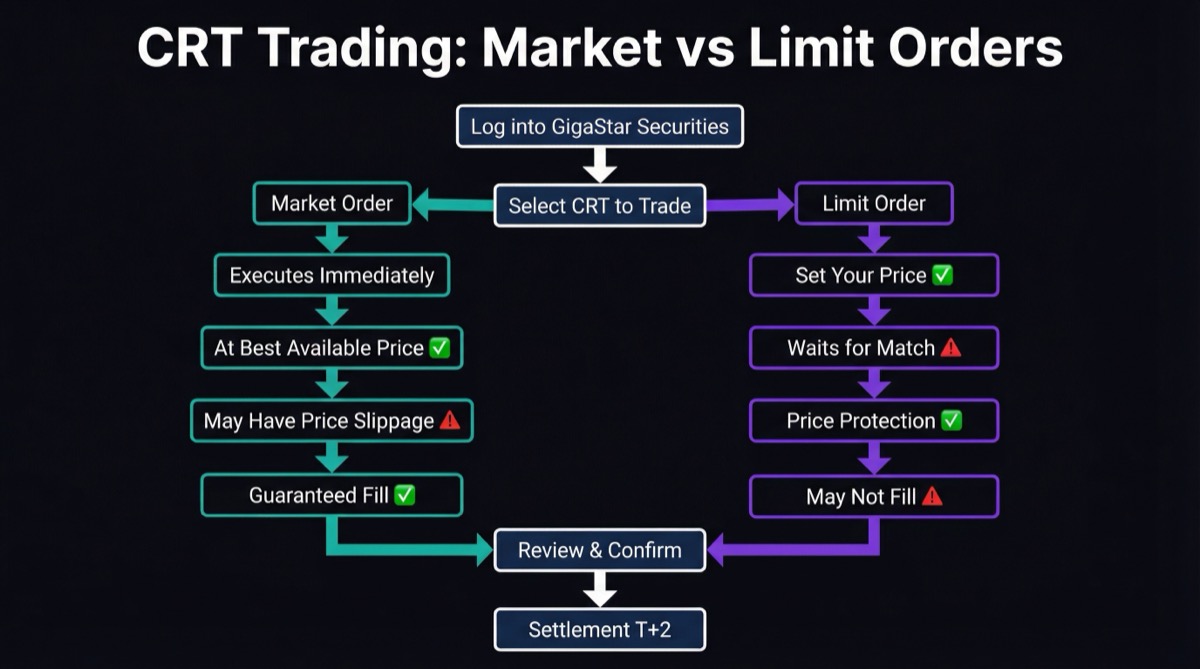
You will need to decide between a market order and a limit order (more details on each type below). In general:
- Market order: Your CRTs will be sold at the best available price from existing buy orders on the book
- Limit order: You set a minimum price, and your order will only execute at that price or higher
Step 4: Specify the Quantity
Enter the number of CRTs you want to sell. You do not have to sell your entire holding. You can sell a portion and retain the rest.
Step 5: Review and Confirm
Before submitting, review all the details of your order:
- CRT name and identifier
- Order type (market or limit)
- Quantity
- Price (for limit orders) or estimated execution price (for market orders)
- Any applicable fees
Once you confirm, your order will be submitted to the order book.
Step 6: Monitor Your Order
After submission, your order enters the order book. If it does not execute immediately (which is common with limit orders or when there are no matching buy orders), it will remain open until it is filled, you cancel it, or it expires.
How to Place a Buy Order
Buying CRTs on the Secondary Market follows a similar process, but from the other side of the transaction.
Step 1: Log In and Navigate to the Marketplace
Access the GigaStar Securities trading interface. You should be able to browse available CRT listings and see which offerings have active sell orders.
Step 2: Select a CRT to Purchase
Browse the available offerings. For each CRT, you should be able to see:
- The Creator's channel name and key metrics
- The terms of the CRT (revenue share, duration)
- Current ask prices (what sellers are listing at)
- Recent trading activity (if any)
Step 3: Choose Your Order Type
As with selling, you can place either a market order or a limit order:
- Market order: You will buy at the lowest available ask price
- Limit order: You set a maximum price you are willing to pay, and your order only executes at that price or lower
Step 4: Specify the Quantity and Confirm
Enter the number of CRTs you want to buy, review the order details (including estimated cost and fees), and confirm your order.
Step 5: Wait for Execution
Your buy order enters the order book. If a matching sell order exists, the trade may execute immediately. If not, your order will remain open until matched, canceled, or expired.
Market Orders vs Limit Orders
Understanding the difference between market orders and limit orders is essential for trading on the Secondary Market. Each type serves a different purpose, and choosing the right one depends on your priorities.
Market Orders
A market order instructs the system to execute your trade at the best available price right now. Here is what that means in practice:
Advantages:
- Speed: Market orders execute immediately if there is a matching order on the other side
- Simplicity: You do not need to specify a price
- Certainty of execution: If there are orders on the book, your trade will fill
Considerations:
- Price uncertainty: You may not get the exact price you expected, especially if the order book is thin (few orders available)
- Slippage: In a market with limited liquidity, the execution price could differ significantly from the last traded price
- No price protection: There is no cap on how much you might pay (for buy orders) or floor on how little you might receive (for sell orders)
Market orders are best used when execution speed is more important to you than getting a specific price, and when you have reviewed the order book and understand the likely execution price.
Limit Orders
A limit order lets you specify the exact price at which you are willing to transact. The order will only execute at your specified price or better.
Advantages:
- Price control: You know the worst-case price you will receive (sell) or pay (buy)
- Protection against slippage: You will never execute at a worse price than your limit
- Strategic flexibility: You can set a limit order at your ideal price and wait
Considerations:
- No execution guarantee: If no matching order meets your price, your order will not fill
- Patience required: Limit orders may sit on the book for extended periods
- Partial fills: Your order may execute partially if only some matching volume is available at your price
Limit orders are best used when price is more important to you than speed, when you have a specific valuation in mind, or when you want to protect against unfavorable execution.
Which Should You Use?
For most Investors on the Secondary Market, especially during the early period when liquidity may be limited, limit orders offer more control. They allow you to set the price you are comfortable with and avoid surprises. Market orders can be useful when you see a price on the book that you are happy with and want to act quickly.
Understanding the Order Book
The order book is the central mechanism that drives trading on the Secondary Market. Understanding how it works will make you a more informed trader.
What Is the Order Book?
The order book is a real-time list of all open buy and sell orders for a given CRT. It shows:
- Bids: Buy orders, listed from highest price to lowest. These represent what buyers are willing to pay.
- Asks: Sell orders, listed from lowest price to highest. These represent what sellers are asking.
The difference between the highest bid and the lowest ask is called the bid-ask spread. A narrow spread generally indicates more active trading, while a wide spread may indicate limited activity.
Price-Time Priority
When multiple orders exist at the same price, the order book uses price-time priority to determine which order gets filled first:
- Price priority: The best-priced orders execute first (highest bids and lowest asks)
- Time priority: Among orders at the same price, the order that was placed first gets filled first
This means that if you place a limit buy order at a given price, and another Investor places a buy order at the same price after you, your order will be filled first when a matching sell order comes in.
Reading the Order Book
When you look at the order book for a CRT, you might see something like this:
Buy Orders (Bids)
| Price | Quantity |
|---|---|
| $9.50 | 50 |
| $9.25 | 100 |
| $9.00 | 75 |
Sell Orders (Asks)
| Price | Quantity |
|---|---|
| $10.00 | 30 |
| $10.25 | 80 |
| $10.50 | 45 |
In this example, the highest bid is $9.50 and the lowest ask is $10.00, creating a bid-ask spread of $0.50. A market sell order would execute at $9.50, and a market buy order would execute at $10.00. A limit buy order at $9.75 would sit on the book until a seller is willing to sell at $9.75 or lower.
Why the Order Book Matters
The order book gives you critical information about market conditions:
- Depth: How many CRTs are available at various price levels. More depth generally means less price impact for your order.
- Spread: A wide spread may mean you should use limit orders to avoid unfavorable execution.
- Activity: An active order book with many orders at various prices suggests healthy trading interest.
Settlement and Transfer Process
When a trade executes on the Secondary Market, there is a process between execution and the finalization of the transfer. This is called settlement.
What Happens After a Trade Executes
Once a buy order and sell order match and a trade executes:
- Trade confirmation: Both the buyer and seller receive confirmation that the trade has been executed, including the price and quantity
- Settlement period: There is a defined period during which the transfer of CRTs and funds is processed. Settlement times will be announced before the Secondary Market launch
- CRT transfer: The CRTs are transferred from the seller's account to the buyer's account
- Funds transfer: The purchase funds are transferred from the buyer to the seller, minus any applicable fees
Important Settlement Considerations
- Pending settlement: During the settlement period, the CRTs being sold are typically locked and cannot be traded again
- Distribution timing: If a monthly distribution occurs during the settlement period, the determination of who receives that distribution will follow specific rules outlined in the platform's terms
- Failed settlement: In rare cases, a settlement may fail (for example, due to a funding issue). The platform will have procedures for handling failed settlements
Trading Fees and Costs
Trading on the Secondary Market involves costs that both buyers and sellers should understand and account for.
Types of Fees
While specific fee amounts will be announced before the Secondary Market launch, here are the types of costs you should anticipate:
- Transaction fees: A per-trade fee charged when an order executes. This may be a flat fee, a percentage of the trade value, or a combination
- Platform fees: There may be ongoing fees associated with maintaining a GigaStar Securities account
- Regulatory fees: Small fees that may be passed through to cover regulatory costs
How Fees Affect Your Trading
Fees reduce the net amount you receive when selling and increase the total cost when buying. This is especially important for:
- Frequent trading: If you plan to trade often, fees can add up and significantly affect your results
- Small trades: For small transactions, a fixed fee component can represent a larger percentage of the trade value
- Break-even analysis: When setting limit order prices, factor in fees to understand your true break-even point
Fee Transparency
GigaStar Securities will publish a complete fee schedule before the Secondary Market opens. Review this schedule carefully so there are no surprises when you start trading.
Smart Trading Considerations
Trading CRTs on the Secondary Market requires thoughtful decision-making. Here are considerations that may help you approach trading more strategically.
Do Your Research
Before buying or selling any CRT, take the time to understand what you are trading:
- Channel performance: Review the Creator's recent YouTube metrics, including views, subscriber growth, and content consistency
- Revenue trends: Look at how the Creator's revenue has trended over recent months. Is it growing, stable, or declining?
- Offering terms: Understand the revenue share percentage, duration, and any other terms specific to the CRT
- Comparable offerings: If multiple Creator CRTs are available, compare their terms and performance to understand relative value
Consider Your Timing
The timing of your trades can matter:
- Monthly distribution dates: CRT prices may fluctuate around distribution dates. Be aware of when distributions are calculated and paid
- Creator milestones: Major Creator events (channel milestones, new content launches, or controversies) may affect demand for their CRTs
- Market conditions: Broader market sentiment and activity levels on the Secondary Market can influence pricing
Set Realistic Price Expectations
The Secondary Market is not a traditional stock exchange with thousands of participants. Pricing dynamics will be different:
- Limited comparables: Unlike publicly traded stocks with extensive analyst coverage, CRTs do not have widely available price targets
- Thin order books: Especially during the early period, there may be few orders on the book, which means the price you see may not be available for the quantity you want to trade
- Bid-ask spreads: Expect wider spreads than you might be accustomed to from public stock markets. This is normal for newer and less liquid markets
Avoid Emotional Decision-Making
Like any investment, CRT trading can trigger emotional responses. A few principles to keep in mind:
- Have a plan: Before trading, decide what price you would be willing to buy or sell at and why
- Avoid chasing: If a CRT price moves quickly, resist the urge to chase the price without understanding what is driving the movement
- Accept uncertainty: The Secondary Market is new, and it will take time for price discovery to mature. Not every trade will go the way you expect
What Could Go Wrong
Every Investor should understand the risks involved in Secondary Market trading. Being aware of potential problems helps you prepare for them.
Execution Risk
- No matching orders: You may place a sell order and find no buyers at your price, or place a buy order and find no sellers. The Secondary Market does not guarantee execution
- Partial fills: Your order may only partially execute if there is not enough volume at your price
- Price slippage: Market orders may execute at prices worse than expected, especially in thin markets
Pricing Risk
- Mispricing: Without deep market data, it can be difficult to determine the "right" price for a CRT. You may buy at a price that later appears too high, or sell at a price that later appears too low
- Stale prices: If a CRT has not traded recently, the last traded price may not reflect current conditions
- Valuation challenges: CRT values depend on future Creator revenue, which is inherently uncertain
Liquidity Risk
- Inability to sell: Even with the Secondary Market, there is no assurance you will be able to sell your CRTs when you want to. If there are no buyers, your CRTs remain in your account
- Wide spreads: Low liquidity can result in significant differences between what buyers are offering and what sellers are asking
- Price impact: In a thin market, even a moderately sized order can move the price significantly
Operational Risk
- Platform issues: Like any technology platform, the Secondary Market could experience technical difficulties, outages, or delays
- Order errors: Placing an order with the wrong price, quantity, or order type can result in unintended trades. Always double-check before confirming
- Account issues: Ensure your account is properly set up and funded before attempting to trade to avoid delays or failed settlements
Regulatory Risk
- Rule changes: Regulations governing the Secondary Market could change, affecting how trading works or what CRTs are eligible for trading
- Trading halts: There may be circumstances under which trading in a specific CRT or the entire market is temporarily halted
Key Takeaways
- Account setup first: You need a GigaStar Securities account to trade on the Secondary Market. Existing GigaStar Market Investors will go through a migration process.
- 12-month holding period for sellers: You cannot sell CRTs until you have held them for at least 12 months from the date of purchase.
- Two order types: Market orders prioritize speed; limit orders prioritize price control. Limit orders may be more appropriate for the early market period.
- The order book is your guide: Before trading, review the order book to understand current pricing, depth, and spread.
- Settlement takes time: Trades do not settle instantly. Understand the settlement timeline before trading.
- Fees affect results: Factor transaction costs into your buy and sell decisions.
- Research thoroughly: Understand the Creator, the CRT terms, and current market conditions before placing any trade.
- Liquidity will be limited: Especially at launch, do not assume you can buy or sell at any time or at any price.
- All trading involves risk: You could lose some or all of your investment. Never trade more than you can afford to lose.
Frequently Asked Questions
Can I sell any CRT I own?
Only CRTs held for 12 months or longer are eligible for resale on the Secondary Market. This holding period is a regulatory requirement under SEC Regulation Crowdfunding. If you purchased CRTs less than 12 months ago, you will need to wait until the holding period expires before listing them for sale on the Secondary Market.
What types of orders can I place?
The Secondary Market supports market orders (execute at best available price) and limit orders (execute only at your specified price or better). Market orders prioritize execution speed, while limit orders give you control over the price at which your trade executes. Both order types have advantages and trade-offs depending on your goals and the current state of the order book.
How long does settlement take?
Settlement times will be announced closer to launch. Securities transactions typically settle within a defined period after the trade executes. During the settlement window, the CRTs and funds involved in the trade are in transit between buyer and seller accounts. You should not plan on being able to re-trade CRTs or access funds until settlement is complete.
Are there fees for trading?
Trading fees will be announced before the Secondary Market launch. Both buyers and sellers should expect transaction costs. These may include per-trade fees, platform fees, or regulatory pass-through charges. Review the complete fee schedule published by GigaStar Securities so you can factor costs into your trading decisions.
What happens to my distributions when I sell?
Once you sell your CRTs, the new holder receives all future monthly distributions. You retain any distributions paid before the sale settles. If a distribution is calculated during the settlement period, the specific rules for who receives that distribution will be outlined in the platform's trading terms. Always check the distribution calendar relative to your planned trade timing.
This content is for educational purposes only and does not constitute investment advice. All investments involve risk, including the potential loss of your entire investment.