Scenario Analysis: Investment Outcome Possibilities
What are the possible outcomes of a CRT investment?
CRT investment outcomes range from receiving distributions that exceed your original investment over time if a Creator's channel grows, to total loss of invested capital if a Creator's channel is terminated or revenue falls to zero. Most outcomes will fall somewhere between these extremes.
Educational Content: This content is for educational purposes only and does not constitute investment advice. All investments involve risk, including potential loss of principal. See full disclosures.
Why Scenario Analysis Matters
When considering a Channel Revenue Token (CRT) investment, the most common mistake is anchoring on a single expected outcome. An Investor might look at a Creator's recent revenue history, project those numbers forward, and conclude that the investment will perform well. Or they might focus on worst-case fears and avoid the investment entirely. Neither approach is complete.
Scenario analysis is a framework for thinking about the full range of possible outcomes. Rather than predicting what will happen, it maps out what could happen under different conditions. This approach forces you to consider favorable scenarios, unfavorable scenarios, and everything in between. It does not remove uncertainty — nothing can. But it gives you a more honest picture of what you are accepting when you invest.
This is particularly important for CRT investments because the outcomes are driven by multiple independent variables: Creator performance, YouTube platform conditions, ad market dynamics, audience behavior, and macroeconomic factors. These variables interact in complex ways, and their future trajectories are inherently unpredictable.
This article walks through four illustrative scenarios — not as predictions, but as a framework for thinking about what is possible. No specific numbers are provided because every Creator offering has unique characteristics. The purpose is to help you develop the mental models for evaluating any CRT offering you consider.
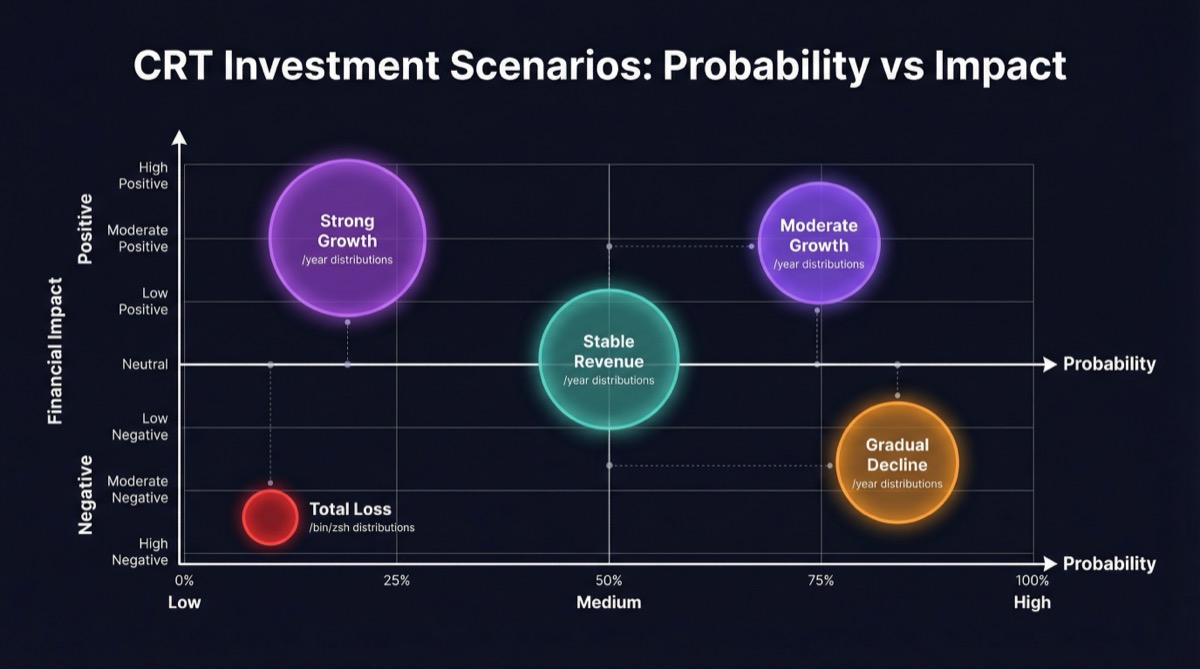
Scenario One: Sustained Channel Growth
What This Looks Like
In this scenario, the Creator's channel performs well over the investment period. The Creator continues to upload consistently, content quality remains high or improves, and the audience grows. YouTube's algorithm favors the Creator's content, leading to increased recommendations and views. CPMs remain stable or increase due to favorable ad market conditions and the Creator operating in a strong advertising niche.
Contributing Factors
Multiple things need to go right for this scenario to materialize:
- Creator execution: The Creator maintains motivation, consistently produces compelling content, and avoids burnout. They adapt to audience preferences and platform changes effectively.
- Audience growth: New viewers discover the channel through algorithmic recommendations, search, or external promotion. Existing subscribers remain engaged and continue watching new uploads.
- Platform stability: YouTube maintains its current monetization structure, revenue-sharing terms, and algorithmic treatment of the Creator's content category. No adverse policy changes affect the channel.
- Ad market health: Advertiser spending remains strong, CPMs in the Creator's niche hold steady or increase, and seasonal patterns follow historical norms.
- Niche dynamics: The Creator's content niche remains relevant and in demand. Competition does not erode the Creator's audience share significantly.
What This Means for Investors
In a growth scenario, monthly distributions to CRT holders would tend to increase over time as the Creator's revenue grows. The cumulative distributions received over the investment period could potentially exceed the original investment amount. This represents the most favorable end of the outcome spectrum.
However, even in a growth scenario, distributions will not increase in a straight line. Month-to-month variability is normal due to seasonal CPM fluctuations, differences in content performance, and other factors. A generally positive trajectory will still include months where distributions are lower than the previous month.
Why This Outcome Is Not Assured
A Creator's historical growth rate is a data point, not a guarantee. Many Creators who grew rapidly in one period experienced plateaus or declines in subsequent periods. Audience growth tends to slow as a channel matures and its addressable audience becomes more fully penetrated. Content formats that drove growth in the past may become less effective. External factors — algorithm changes, new competitors, shifting viewer preferences — can interrupt even the strongest growth trajectories.
Scenario Two: Stable Performance
What This Looks Like
In this scenario, the Creator continues producing content at roughly the same level of quality and frequency. Their audience neither grows significantly nor declines significantly. YouTube's algorithm treats the channel consistently. CPMs fluctuate within normal seasonal ranges but do not trend strongly in either direction. The channel essentially maintains the status quo.
Contributing Factors
Stability requires a balance of factors:
- Creator consistency: The Creator continues to upload at a steady pace without significant changes in content quality, format, or direction. No major life events disrupt their production schedule.
- Audience equilibrium: New subscriber acquisition roughly matches natural audience attrition. Viewership per video remains in a consistent range.
- Platform continuity: YouTube does not make changes that significantly benefit or harm the channel. The algorithm neither promotes nor suppresses the Creator's content relative to its baseline.
- Steady ad market: CPMs follow typical seasonal patterns without dramatic shifts. No major changes in advertiser preferences affect the Creator's niche.
What This Means for Investors
In a stability scenario, distributions remain in a relatively consistent range, adjusting for normal seasonal variability. Distributions in Q4 (October through December) may be higher due to elevated holiday-season CPMs, while Q1 (January through March) distributions may be lower as ad budgets reset. But the overall annual pattern would be roughly similar from year to year.
Over a multi-year period, the cumulative distributions would represent a portion of the original investment amount. The specific proportion depends on the terms of the individual CRT offering, including the revenue-share percentage and the Creator's revenue level.
Why Stability Is Not the Default Expectation
It is tempting to treat stability as the baseline assumption, but true stability over a multi-year period is actually a specific outcome that requires specific conditions to persist. The Creator Economy is dynamic. YouTube makes changes. Audience preferences shift. Niches rise and fall. Creators evolve or stagnate. The probability of everything remaining essentially unchanged over many years is lower than intuition might suggest.
Stability is a possible outcome, not a probable one. Investment decisions should not be anchored to the assumption that current conditions will persist indefinitely.
Scenario Three: Gradual Decline
What This Looks Like
In this scenario, the Creator's channel experiences a sustained decline in performance over time. This might manifest as gradually decreasing viewership, declining CPMs in the Creator's niche, reduced upload frequency, or some combination of these factors. The decline is not catastrophic — the channel continues to operate and generate some revenue — but the trajectory is clearly downward.
Contributing Factors
Decline can result from a variety of factors, often acting in combination:
- Content fatigue: The Creator's format or niche loses novelty. Audiences who were initially enthusiastic become less engaged over time. The Creator may struggle to innovate while retaining their existing audience.
- Increased competition: New Creators enter the niche and capture audience attention. The Creator's share of the available audience diminishes even if the total niche audience remains stable or grows.
- Reduced Creator output: The Creator decreases upload frequency due to burnout, shifting priorities, other business commitments, or personal circumstances. Fewer uploads mean fewer views and less revenue.
- Algorithm drift: YouTube's algorithm gradually deprioritizes the Creator's content type. This can happen subtly over months or years as YouTube adjusts its recommendation systems to favor different content characteristics.
- CPM compression: Advertiser spending in the Creator's niche declines, or YouTube restructures its ad products in ways that reduce the effective CPM for the Creator's content category.
What This Means for Investors
In a decline scenario, distributions decrease over time. Each month's distribution may be slightly lower than the previous months, with the downward trend punctuated by seasonal variations and individual video performance. The cumulative distributions received over the investment period would be lower than in the stability scenario, and potentially substantially lower depending on the severity and speed of the decline.
The challenge with a gradual decline is that it may not be immediately obvious. A few months of lower distributions could be attributed to seasonal factors or normal variability. By the time a clear downward trend is established, the decline may have been underway for some time. The illiquid nature of CRTs means you cannot easily exit when you recognize a decline is occurring.
The Compounding Effect of Decline
Decline tends to compound. Fewer uploads lead to reduced algorithmic promotion, which leads to fewer views, which may demotivate the Creator, leading to even fewer uploads. A shrinking audience provides less engagement feedback, making it harder for the Creator to understand what content to produce. Revenue decline may cause the Creator to seek income from other sources, further reducing their attention to YouTube. This negative feedback loop can accelerate what begins as a mild decline into a more serious one.
Scenario Four: Severe Disruption or Total Loss
What This Looks Like
In this scenario, a major adverse event significantly disrupts or entirely eliminates the revenue stream backing the CRT. This is the worst-case end of the outcome spectrum, and it represents the most important scenario for Investors to internalize because it involves the potential loss of all invested capital.
Possible Triggers
Several events could cause severe disruption or total loss:
- Channel termination: YouTube terminates the Creator's channel due to repeated policy violations, copyright strikes, community guideline violations, or other terms-of-service breaches. A terminated channel generates zero revenue.
- Creator permanent departure: The Creator stops producing content permanently due to burnout, career change, health issues, legal problems, or other personal circumstances. An inactive channel's viewership and revenue decline toward zero over time.
- Full demonetization: YouTube removes the Creator from the YouTube Partner Program due to policy violations or eligibility changes. A demonetized channel earns no ad revenue.
- Platform-wide disruption: A systemic event — such as a severe advertiser boycott, regulatory action against YouTube, or fundamental change in YouTube's business model — dramatically reduces ad revenue across the platform.
- Reputational crisis: A public controversy involving the Creator leads to advertiser withdrawal, audience abandonment, and potential YouTube action against the channel. The combined impact could reduce revenue to near zero.
What This Means for Investors
In a severe disruption scenario, distributions could decline rapidly or cease entirely. If the disruption is permanent — channel termination, permanent Creator departure, or irreversible demonetization — the revenue stream that backs the CRT is gone. The investment has no residual value. There are no hard assets to liquidate, no corporate balance sheet to recover from, and no insurance program for CRT holders.
Total loss means exactly what it says: every dollar invested is gone with no mechanism for recovery. This is the most important outcome to understand because it sets the floor for any CRT investment. The floor is zero.
The Speed of Catastrophic Events
Unlike gradual decline, which unfolds over months or years, some catastrophic events happen quickly. A channel can be terminated in a single day. A reputational crisis can unfold over a weekend. A YouTube policy change can take effect immediately. The speed of these events means there may be no opportunity to react, no warning period, and no time to attempt an exit through the Secondary Market — even if the Secondary Market were liquid, which it may not be.
How Multiple Factors Interact
Real-world outcomes rarely result from a single factor operating in isolation. More commonly, multiple factors combine to shape the investment outcome.
Negative Combinations
Consider the following sequence: An economic downturn reduces advertising budgets, compressing CPMs across YouTube. Simultaneously, the Creator experiences burnout and reduces upload frequency from three times per week to once per week. YouTube's algorithm, which favors consistent uploaders, reduces the Creator's recommended traffic. The Creator's niche becomes more competitive as new Creators enter the space. Each factor individually might cause a modest distribution decline, but together they create a substantial one.
This type of combination is not unlikely. Economic cycles, Creator burnout, algorithm evolution, and competitive dynamics are all normal occurrences. The question is not whether multiple adverse factors will occur simultaneously, but when and to what degree.
Positive Combinations
Factors can also combine favorably. A Creator enters a content niche that is gaining popularity, advertisers increase spending in that niche, YouTube's algorithm promotes the Creator's content, and the Creator's production quality improves. The resulting revenue growth would benefit CRT holders through increased distributions.
However, positive factor combinations are no more predictable than negative ones. Investors should not assume favorable alignment of factors any more than they should assume unfavorable alignment.
The Illiquidity Overlay
Across all scenarios, illiquidity shapes the Investor experience. In a growth scenario, illiquidity means you cannot easily take gains by selling your position (though you do receive ongoing distributions). In a decline scenario, illiquidity means you cannot cut your losses by selling. In a catastrophic scenario, illiquidity is irrelevant because the investment has no value regardless of whether you can sell it.
The illiquid nature of CRTs amplifies the importance of getting the initial investment decision right. There is no easy correction mechanism if conditions deteriorate.
Using Scenario Analysis in Your Investment Decisions
Ask the Right Questions
For every CRT offering you consider, walk through each scenario and ask:
- Growth scenario: What specific factors would drive growth for this Creator? How realistic are those factors? How much of the Creator's past growth depended on conditions that may not persist?
- Stability scenario: What would need to remain unchanged for this Creator to maintain current performance? How likely is that level of continuity given industry dynamics?
- Decline scenario: What factors could cause a gradual decline? How resilient is this Creator's content and audience to competitive pressure, platform changes, and content fatigue?
- Severe disruption scenario: What events could cause total loss? How exposed is this Creator to demonetization risk, reputational risk, or burnout?
Weight Your Assessment Honestly
It is human nature to overweight favorable scenarios and underweight unfavorable ones, particularly after researching a Creator you find compelling. Guard against this tendency. The most useful scenario analysis is the one that gives honest weight to outcomes you would prefer not to think about.
Ask yourself: if the worst case materialized, would the loss of this investment cause you financial hardship? If the answer is yes, the investment amount is too large relative to your financial situation, regardless of how favorable the other scenarios may appear.
Invest Only What You Can Lose
This principle bears repeating because it is the practical conclusion of any honest scenario analysis. Every CRT investment has a non-trivial probability of resulting in total loss. The probability may be small for a well-established Creator, but it is never zero. Size your investment so that the total loss scenario, while unpleasant, would not materially harm your financial well-being.
Key Takeaways
- CRT outcomes exist on a spectrum. The range runs from cumulative distributions exceeding your investment (growth scenario) to total loss of all invested capital (severe disruption scenario). No outcome should be assumed.
- Growth requires multiple favorable factors to persist. Creator consistency, audience growth, platform stability, and healthy ad markets all need to continue performing well. Past growth does not guarantee future growth.
- Stability is a specific outcome, not a default. Assuming current conditions will persist indefinitely is an assumption that requires justification, not the absence of one.
- Gradual decline compounds. Declining viewership, reduced upload frequency, and lower CPMs can create negative feedback loops that accelerate over time.
- Total loss is possible and may occur quickly. Channel termination, permanent Creator departure, or platform-wide disruption can eliminate the revenue stream with little or no warning.
- Multiple factors interact. Real-world outcomes are shaped by combinations of Creator, platform, market, and audience factors that may amplify or offset each other.
- Illiquidity amplifies all scenarios. You cannot easily sell your position to capture gains in a growth scenario or cut losses in a decline scenario.
- Invest only what you can afford to lose entirely. This is the most important practical takeaway from any scenario analysis of CRT investments.
This content is for educational purposes only and does not constitute investment advice. Channel Revenue Token investments involve significant risk, including potential total loss of invested capital. Past performance does not predict future results.
Frequently Asked Questions
What is the best possible outcome from a CRT investment?
In the most favorable scenario, a Creator's YouTube channel grows significantly over the life of the investment. Viewership increases, CPMs remain strong or improve, and the Creator consistently produces content that performs well with audiences and the YouTube algorithm. In this scenario, monthly distributions to CRT holders would tend to increase over time as the Creator's revenue grows. The total cumulative distributions received over the investment period could potentially exceed the original amount invested. However, this outcome requires multiple favorable factors to persist simultaneously over an extended period, which cannot be predicted or guaranteed. Past channel performance, including strong growth, does not ensure that growth will continue.
What is the worst-case outcome from a CRT investment?
The worst-case outcome is total loss of your entire invested capital, with no mechanism for recovery. This could happen if a Creator's YouTube channel is terminated due to policy violations or copyright strikes, if the Creator permanently stops producing content, if the channel is demonetized and cannot regain monetization status, or if a combination of adverse factors reduces the channel's revenue to zero. In a total loss scenario, CRT distributions cease permanently, the investment has no residual value, there are no assets to liquidate, and there is no insurance program that compensates CRT holders. Every CRT Investor must accept that total loss is a possible outcome before committing capital.
Are CRT distributions fixed or do they change over time?
CRT distributions are entirely variable. They are calculated from the Creator's actual YouTube ad revenue, which changes from month to month based on multiple factors: the number and performance of videos the Creator publishes, total channel viewership, the CPMs paid by advertisers (which fluctuate seasonally and with economic conditions), YouTube's monetization policies, and algorithm-driven traffic. Distributions in the fourth quarter of the year are often higher due to elevated holiday-season advertising spending, while first-quarter distributions are typically lower. Beyond seasonal patterns, distributions can increase if a Creator's channel grows or decrease if performance declines. There is no minimum distribution amount and no guarantee of any specific distribution level.
How should I think about the range of possible CRT outcomes?
The most useful approach is to evaluate each CRT investment across the full spectrum of possible outcomes rather than anchoring on any single expectation. Consider what would happen in a growth scenario (Creator's channel expands significantly), a stability scenario (channel maintains current performance), a decline scenario (channel gradually loses viewership and revenue), and a severe disruption scenario (revenue falls to zero). Assess the factors that would drive each scenario for the specific Creator you are evaluating, and honestly weigh both favorable and unfavorable possibilities. The critical test is whether you can accept the worst-case outcome — total loss — without material financial hardship. If you cannot, the investment amount is too large for your situation, regardless of how favorable the other scenarios appear.
For a comprehensive analysis of all CRT risk factors, see Understanding Creator Investing Risks.