Crowdfunding Investment Limits Explained
How much can I invest in Regulation Crowdfunding offerings?
SEC Regulation Crowdfunding limits how much non-accredited investors can invest annually based on income and net worth. Accredited investors meeting specific thresholds may invest without these limits.
Educational Content: This content is for educational purposes only and does not constitute investment advice. All investments involve risk, including potential loss of principal. See full disclosures.
Why Investment Limits Exist
SEC Regulation Crowdfunding (Reg CF) was designed with a specific dual purpose: to open early-stage investing to everyday Americans while simultaneously protecting those Investors from taking on excessive risk. Investment limits are the primary mechanism through which the SEC achieves that second goal.
Before Reg CF existed, investing in private companies was largely restricted to accredited Investors — individuals with high incomes or substantial net worth. The assumption was that wealthy Investors could absorb potential losses more easily and had greater access to financial expertise. When Congress passed the JOBS Act in 2012 and the SEC implemented Reg CF rules, the challenge was clear: how do you let regular people participate in private investments without exposing them to the possibility of catastrophic financial loss?
The answer was investment limits tied to income and net worth. The logic is straightforward: the less you earn and the less you have saved, the less you should be putting at risk in speculative, illiquid investments. Reg CF offerings — including Channel Revenue Token (CRT) offerings on GigaStar Market — are speculative investments with material risk, including the possibility of total loss. The SEC's investment limits are designed to prevent any individual Investor from concentrating too much of their capital in this asset class.
It is essential to understand that these limits are not arbitrary bureaucratic restrictions. They exist because Reg CF investments carry meaningfully different risk characteristics than, for example, buying shares of a publicly traded company on a stock exchange. Reg CF securities are typically illiquid, may not have an active secondary market, and involve companies or offerings with limited operating history. The investment limits acknowledge these risks and provide a structured boundary to help Investors manage their overall exposure.
Understanding your investment limit is a foundational step before making any Reg CF investment. The calculation is based on publicly defined formulas, and every SEC-registered funding portal — including GigaStar Market — is required to help Investors determine their limit before completing an investment.
How Reg CF Limits Are Calculated
The SEC defines two tiers of investment limits based on your annual income and net worth. The formulas are straightforward, but the details matter.
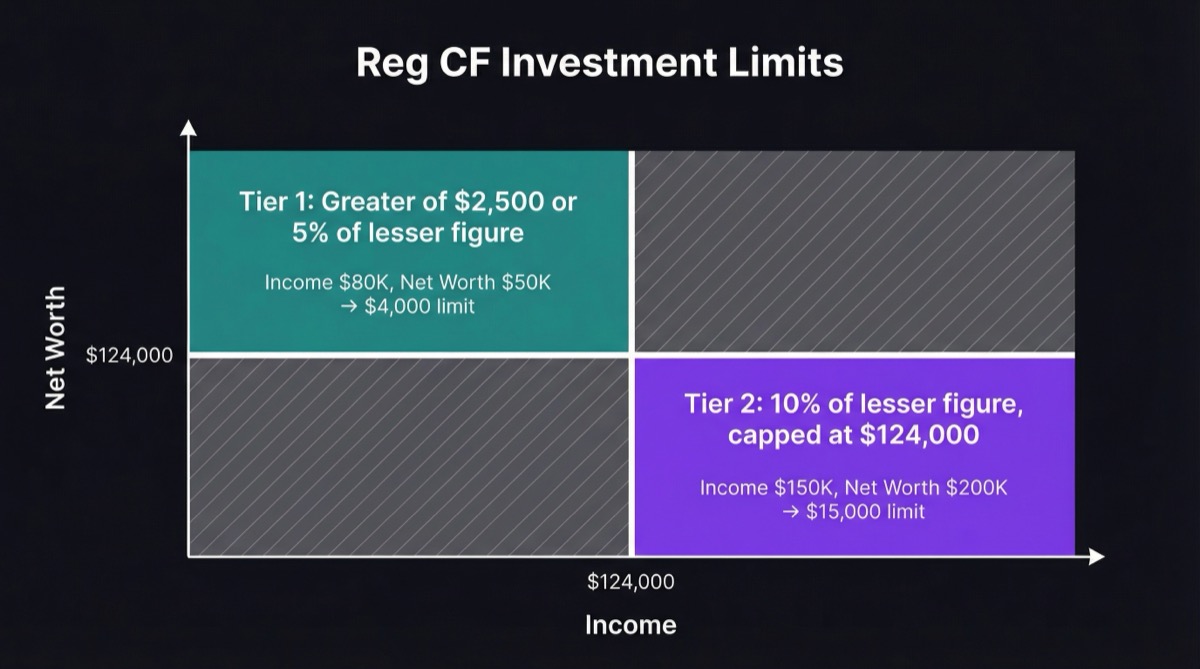
Tier 1: Both Income and Net Worth Below $124,000
If both your annual income and your net worth are below $124,000, your annual Reg CF investment limit is:
The greater of $2,500 or 5% of the lesser of your annual income or net worth.
This means you always have a minimum limit of $2,500, regardless of how low your income or net worth may be. The 5% calculation uses whichever figure is lower — your income or your net worth — as the basis.
Tier 2: Either Income or Net Worth Is $124,000 or More
If either your annual income or your net worth is $124,000 or more (but you are not an accredited Investor), your annual Reg CF investment limit is:
10% of the lesser of your annual income or net worth, up to a maximum of $124,000.
This tier provides a higher limit because the SEC considers individuals with at least one financial metric at or above $124,000 to have greater capacity to absorb potential losses. However, the cap at $124,000 ensures that even relatively wealthy non-accredited Investors cannot concentrate unlimited capital in Reg CF offerings.
Important Notes on the Calculation
- Net worth excludes your primary residence. When calculating net worth for Reg CF purposes, you do not include the value of the home you live in. This is consistent with the SEC's approach to net worth calculations in other securities regulations.
- Income means annual income. The SEC uses your annual income, which you self-report. This typically corresponds to your gross annual income, though the SEC does not prescribe a specific definition.
- The $124,000 threshold is periodically adjusted. The SEC reviews and may adjust this threshold to account for inflation. Always check current SEC guidance for the most up-to-date figures.
- You self-certify your income and net worth. While funding portals verify that your stated figures produce a limit consistent with your investment amount, you are responsible for providing accurate information.
Worked Examples
To make the formulas concrete, here are several examples showing how the limits work in practice.
Example 1: Sarah has an annual income of $45,000 and a net worth of $30,000. Both figures are below $124,000, so she falls into Tier 1. The lesser of income and net worth is $30,000. Five percent of $30,000 is $1,500. Since $1,500 is less than the $2,500 floor, Sarah's limit is $2,500.
Example 2: Marcus has an annual income of $80,000 and a net worth of $100,000. Both figures are below $124,000, so he falls into Tier 1. The lesser is $80,000. Five percent of $80,000 is $4,000. Since $4,000 exceeds the $2,500 floor, Marcus's limit is $4,000.
Example 3: Elena has an annual income of $150,000 and a net worth of $90,000. Her income exceeds $124,000, so she falls into Tier 2. The lesser of income and net worth is $90,000. Ten percent of $90,000 is $9,000. Elena's limit is $9,000.
Example 4: David has an annual income of $95,000 and a net worth of $200,000. His net worth exceeds $124,000, so he falls into Tier 2. The lesser of income and net worth is $95,000. Ten percent of $95,000 is $9,500. David's limit is $9,500.
Accredited vs Non-Accredited Investors
The SEC draws a clear line between accredited and non-accredited Investors, and this classification determines whether Reg CF investment limits apply to you.
Who Is an Accredited Investor?
An accredited Investor is an individual who meets at least one of the following criteria defined by the SEC:
- Income test: Individual annual income exceeding $200,000 in each of the two most recent years (or joint income with a spouse or partner exceeding $300,000 in each of those years), with a reasonable expectation of the same income level in the current year.
- Net worth test: Individual net worth, or joint net worth with a spouse or partner, exceeding $1,000,000, excluding the value of the person's primary residence.
- Professional certifications: Holders of certain FINRA-recognized professional certifications, designations, or credentials (such as Series 7, Series 65, or Series 82 licenses).
- Knowledgeable employees: Certain employees of private funds.
The income and net worth tests are the most common ways individuals qualify as accredited Investors.
How Accredited Status Affects Reg CF Limits
Accredited Investors are not subject to the Reg CF investment limits described above. If you qualify as an accredited Investor, you may invest in Reg CF offerings without the annual caps that apply to non-accredited Investors. However, all other Reg CF rules — including required disclosures, the right to cancel, and funding portal obligations — still apply.
Why the Distinction Exists
The SEC's rationale for treating accredited and non-accredited Investors differently is rooted in the concept of financial sophistication and loss tolerance. Individuals with higher incomes or greater net worth are presumed — though not assured — to have a greater ability to sustain financial losses from speculative investments and potentially greater access to financial advisors and information.
This does not mean that accredited Investors face less risk. The underlying investment risks of Reg CF offerings are identical regardless of Investor classification. An accredited Investor can lose their entire investment just as easily as a non-accredited Investor. The distinction only affects how much an individual is permitted to invest.
Annual Limit Calculation Examples
The following table summarizes how Reg CF investment limits work across a range of financial situations:
| Annual Income | Net Worth | Tier | Calculation | Annual Limit |
|---|---|---|---|---|
| $45,000 | $30,000 | Tier 1 | Greater of $2,500 or 5% of $30,000 ($1,500) | $2,500 |
| $60,000 | $60,000 | Tier 1 | Greater of $2,500 or 5% of $60,000 ($3,000) | $3,000 |
| $80,000 | $100,000 | Tier 1 | Greater of $2,500 or 5% of $80,000 ($4,000) | $4,000 |
| $150,000 | $90,000 | Tier 2 | 10% of $90,000 | $9,000 |
| $95,000 | $200,000 | Tier 2 | 10% of $95,000 | $9,500 |
| $130,000 | $130,000 | Tier 2 | 10% of $130,000, capped at $124,000 | $13,000 |
| $250,000 | $300,000 | Accredited | Income test met ($200K+ for 2 years) | No Reg CF limit |
| $100,000 | $1,200,000 | Accredited | Net worth test met ($1M+ excluding primary residence) | No Reg CF limit |
Note that the accredited Investor thresholds are separate from the Tier 2 calculation. You do not "graduate" from Tier 2 to accredited simply by exceeding $124,000 — accredited Investor status requires meeting the specific, higher thresholds defined by the SEC.
How Limits Apply Across All Reg CF Offerings
One of the most important — and frequently misunderstood — aspects of Reg CF investment limits is that they are annual and cumulative across all Regulation Crowdfunding offerings on all platforms, not per offering and not per platform.
The Cumulative Rule
Your Reg CF investment limit represents the total amount you may invest in all Reg CF offerings combined within a rolling 12-month period. This includes CRT offerings on GigaStar Market, offerings on other Reg CF funding portals (such as Wefunder, StartEngine, Republic, or any other SEC-registered platform), and any other securities offered under Regulation Crowdfunding.
If your annual limit is $5,000 and you invest $2,000 in a CRT offering on GigaStar Market, you have $3,000 remaining for all other Reg CF investments across all platforms for the rest of that 12-month period. If you then invest $2,000 on another Reg CF platform, your remaining capacity is $1,000 — regardless of which platform you use.
Platform Verification and Investor Responsibility
SEC-registered funding portals like GigaStar Market are required to take steps to verify that Investors do not exceed their Reg CF limits. Typically, this involves asking Investors to self-report their annual income and net worth, calculating the resulting limit, and checking the investment amount against that limit.
However, because no single platform has visibility into your investments on other platforms, Investors bear the ultimate responsibility for tracking their cumulative Reg CF investments. If you invest through multiple Reg CF platforms, you must keep track of your total investments to ensure you remain within your annual limit. No platform can prevent you from exceeding your limit by making investments across different portals that individually fall within the limit but collectively exceed it.
What "12-Month Period" Means
The Reg CF limit operates on a rolling 12-month basis. This means that at any given point, your available investment capacity reflects the total of all Reg CF investments you have made in the preceding 12 months. As older investments fall outside the 12-month window, your available capacity increases accordingly. This is distinct from a calendar-year reset.
Common Questions About Limits
Do Limits Reset Each Year?
The Reg CF limit operates on a rolling 12-month basis rather than a strict calendar-year cycle. Practically speaking, as your oldest Reg CF investments age past the 12-month mark, they no longer count against your current limit. This means your available investment capacity gradually replenishes over time.
Can Married Couples Combine Limits?
Each individual has their own Reg CF investment limit based on their own income and net worth. However, for couples filing jointly, the calculation can use joint income and joint net worth figures. If a married couple uses joint financial figures, the resulting limit applies to the couple's combined Reg CF investments — not to each individual separately. Couples should carefully consider how to report their financial information and track their joint investment activity.
Does the Limit Change if My Income Changes?
Yes. Because the Reg CF limit is based on your current annual income and net worth at the time of investment, a change in either figure changes your limit for subsequent investments. If you receive a significant raise, your limit may increase. If your income decreases, your limit may decrease. Each time you make a Reg CF investment, the platform will ask you to confirm your current financial information.
Does the Limit Apply to Secondary Market Purchases?
Reg CF investment limits apply specifically to primary offerings under Regulation Crowdfunding — the initial sale of securities by the issuer through a funding portal. Transactions on the GigaStar Secondary Market, which is operated by GigaStar Securities (a FINRA-member broker-dealer), are governed by different rules. However, the secondary market has its own regulatory requirements and limitations. Always review the current terms and disclosures for any secondary market activity.
What Is the Minimum Investment for CRT Offerings?
While Reg CF sets the maximum limit, each individual offering may also set a minimum investment amount. Minimum investment amounts for CRT offerings on GigaStar Market are specified in each offering's Form C and on the offering page. The minimum investment varies by offering and is set by the issuer, not by SEC rules.
Using the Investment Limit Calculator
To make the limit calculation process straightforward, GigaStar provides an interactive Investment Limit Calculator at /tools/investment-limit-calculator.
How the Calculator Works
The calculator asks you to input your annual income and your net worth (excluding your primary residence). Based on these inputs, it applies the Reg CF formulas described above and displays your estimated annual investment limit. The tool is designed to be simple and transparent — you can see exactly how the calculation is performed.
Important Caveats
The Investment Limit Calculator provides estimates for educational purposes only. It is not financial advice, and it does not account for Reg CF investments you may have already made on other platforms. You are responsible for tracking your cumulative Reg CF investments and ensuring you remain within your limit.
Additionally, the calculator uses the current SEC thresholds at the time it was built. The SEC periodically reviews and may adjust these thresholds. Always verify that the figures in the calculator match the most current SEC guidance.
If you have questions about your specific financial situation or investment limits, consider consulting a qualified financial professional who can provide personalized guidance.
Key Takeaways
- Reg CF investment limits protect Investors by preventing overconcentration of capital in speculative, illiquid offerings. They are an Investor protection measure, not a barrier.
- Two tiers of limits exist. If both income and net worth are below $124,000, the limit is the greater of $2,500 or 5% of the lesser figure. If either is $124,000+, the limit is 10% of the lesser, capped at $124,000.
- Accredited Investors are exempt from Reg CF limits. Qualification requires $200K+ individual income ($300K+ joint) for two years, or $1M+ net worth excluding primary residence.
- Limits are cumulative across ALL Reg CF platforms, not per offering. Track your total Reg CF investments across GigaStar Market and any other Reg CF funding portals.
- Limits operate on a rolling 12-month basis. As older investments age past 12 months, your available capacity replenishes.
- Always verify current SEC thresholds. The $124,000 threshold and other figures are periodically reviewed and may be adjusted. Check SEC.gov for the most current rules.
Frequently Asked Questions
How much can I invest in Regulation Crowdfunding?
Your annual Reg CF investment limit is determined by two financial figures: your annual income and your net worth (excluding the value of your primary residence). If both figures are below $124,000, your limit is the greater of $2,500 or 5% of the lesser of the two. If either figure is $124,000 or more, your limit is 10% of the lesser of the two, up to a maximum of $124,000 per 12-month period. These limits apply cumulatively across all Reg CF offerings on all platforms. Accredited Investors who meet specific SEC-defined income or net worth thresholds are not subject to these limits.
What is an accredited Investor?
An accredited Investor is a classification defined by the SEC that identifies individuals with sufficient income, net worth, or professional credentials to invest without Reg CF limits. An individual qualifies as accredited if they earned income exceeding $200,000 individually (or $300,000 jointly with a spouse or partner) in each of the two most recent years and reasonably expect the same for the current year. Alternatively, an individual qualifies if their net worth exceeds $1 million, excluding the value of their primary residence. Holders of certain FINRA-recognized professional certifications also qualify.
Do investment limits apply per offering or annually?
Reg CF investment limits are annual and cumulative, not per offering. Your limit represents the maximum total amount you may invest across all Regulation Crowdfunding offerings on all platforms within a rolling 12-month period. If you invest in a CRT offering on GigaStar Market, that amount counts against your limit for all other Reg CF investments during the same period, whether those investments are additional CRT offerings on GigaStar or offerings on entirely different Reg CF platforms. No single platform can track your investments on other platforms, so you are responsible for monitoring your cumulative total.
What happens if I exceed my investment limit?
SEC-registered funding portals like GigaStar Market are required to take steps to verify that Investors do not exceed their Reg CF limits before completing an investment. The platform will ask you to provide your income and net worth, calculate your limit, and check your investment against that limit. However, because limits are cumulative across all Reg CF platforms and no single platform can see your investments elsewhere, the ultimate responsibility for staying within your limit rests with you. If you believe you may be approaching your limit due to investments on multiple platforms, review your total Reg CF investment activity before making additional commitments.
Do Reg CF investment limits apply to GigaStar CRT offerings?
Yes. Channel Revenue Token (CRT) offerings on GigaStar Market are conducted under SEC Regulation Crowdfunding, which means all Reg CF rules apply — including the annual investment limits described in this article. Your Reg CF limit is shared across all Reg CF offerings, so CRT investments on GigaStar Market count against the same annual limit as any other Reg CF investments you make on any platform. The only exception is for accredited Investors, who are not subject to Reg CF investment limits. If you are unsure about your limit or your accredited Investor status, use the Investment Limit Calculator for an estimate or consult a qualified financial professional.
This content is for educational purposes only and does not constitute investment advice. CRT investments involve significant risk, including potential total loss of invested capital. Past performance does not predict future results.