Cash Flow Impact: Fixed Payments vs Variable Revenue Share
How does revenue sharing affect my cash flow compared to fixed loan payments?
Revenue sharing adjusts with your actual income — distributions decrease when revenue dips and increase when it grows. Fixed loan payments stay the same regardless of channel performance.
Educational Content: This content is for educational purposes only and does not constitute investment advice. All investments involve risk, including potential loss of principal. See full disclosures.
Why Cash Flow Matters More Than Total Cost
When Creators evaluate funding options, the conversation often focuses on total cost — how much you will ultimately pay over the life of the arrangement. Total cost matters, but it is not the only factor that determines whether a funding decision is the right one for your business. Cash flow — the timing and variability of your financial obligations — can be equally important, and in some situations, even more important.
A funding option with a lower total cost but rigid payment requirements can put more strain on a Creator's business than an option with a higher total cost but flexible obligations. This is especially true for YouTube Creators, whose revenue is inherently variable. Ad rates fluctuate by season. Algorithm changes can shift viewership overnight. Content breaks, life events, and creative pivots all affect monthly income. Any funding arrangement that does not account for this variability creates a potential mismatch between income and obligations.
Understanding how fixed payments and variable revenue sharing affect cash flow differently is essential for making an informed funding decision. This article walks through the structural differences, practical implications, and scenarios where each model creates distinct cash flow outcomes. For a broader comparison of revenue sharing and traditional loans, see Revenue Sharing vs. Traditional Loans for Creators.
How Fixed Loan Payments Affect Creator Cash Flow
Traditional loans — whether from a bank, an online lender, or a Creator-focused lending platform — typically require fixed monthly payments over a defined repayment period. The payment amount is determined at the outset based on the loan principal, interest rate, and term length. Once set, that payment does not change regardless of how your channel performs.
This structure has a clear advantage: predictability. You know exactly how much you owe every month, which simplifies budgeting and financial planning. For Creators with very stable, consistent revenue, fixed payments may align well with their cash flow.
However, YouTube revenue is rarely perfectly stable. Most Creators experience meaningful revenue fluctuations throughout the year. The advertising market drives much of this variability — CPMs (cost per thousand impressions) are significantly higher in Q4 when advertisers increase holiday spending, and they typically drop in Q1 when ad budgets reset. A Creator earning $20,000 per month in November might earn $11,000 in January.
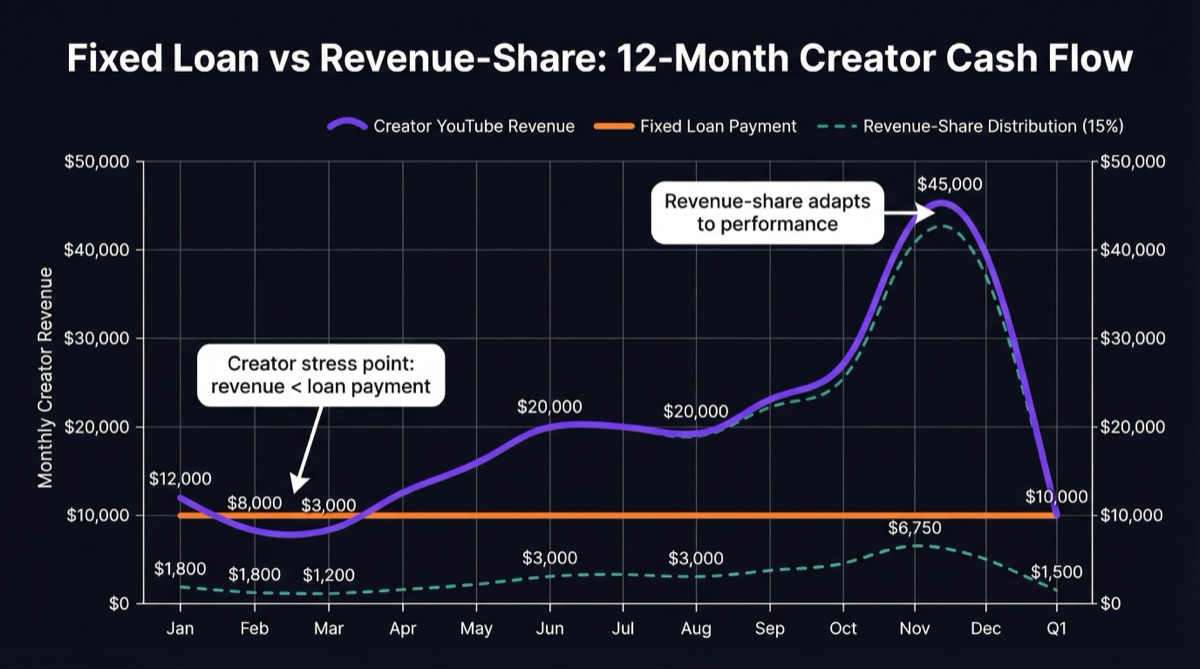
When your obligations are fixed but your income is variable, you face a structural mismatch. During high-revenue months, fixed payments feel manageable. During low-revenue months, the same payment consumes a much larger percentage of your income — and in severe downturns, it may exceed what you can comfortably pay from channel revenue alone.
This mismatch creates several practical problems. First, Creators often need to maintain larger cash reserves to cushion against low months. Capital that could be reinvested in equipment, team, or content production sits in a savings buffer instead. Second, the psychological weight of fixed obligations during slow periods can influence creative decisions — pushing Creators toward content they believe will perform well algorithmically rather than content they are passionate about. Third, if a Creator needs to take an extended break for health, personal reasons, or creative development, the fixed payments continue regardless.
How Variable Revenue Sharing Affects Cash Flow
GigaStar's model works differently. When a Creator conducts a Channel Revenue Token (CRT) offering through GigaStar Market, they agree to share a defined percentage of their YouTube channel revenue with CRT holders for a specified period. The key structural feature is that the obligation is a percentage of actual revenue, not a fixed dollar amount.
This means distributions to CRT holders move in lockstep with the Creator's income. When the channel earns more, the dollar amount distributed increases. When the channel earns less, the dollar amount distributed decreases. The percentage remains constant, but the dollar amount flexes with performance.
Consider a Creator who raises capital through a CRT offering with a 10% revenue share. In a strong month where the channel earns $25,000, the distribution to CRT holders is $2,500, and the Creator retains $22,500. In a slower month where the channel earns $12,000, the distribution is $1,200, and the Creator retains $10,800. The Creator's take-home ratio stays the same regardless of revenue level.
Compare this to a fixed loan payment of, say, $2,000 per month. In the strong $25,000 month, that payment represents 8% of revenue — very manageable. In the slow $12,000 month, the same payment represents nearly 17% of revenue — more than double the relative burden. The fixed payment does not care that the Creator's income dropped.
This proportional structure has several practical benefits for cash flow management. The Creator never faces a situation where obligations consume a disproportionate share of income during a downturn. Cash reserves do not need to be as large because the worst-case monthly obligation is bounded by the revenue itself. And during growth periods, the Creator still retains the same proportion of every incremental dollar earned.
Seasonal Patterns and Revenue Volatility
YouTube revenue follows well-documented seasonal patterns that make the fixed-versus-variable distinction especially relevant for Creators.
Q4 (October-December) is typically the highest-revenue quarter for most YouTube channels. Advertiser demand surges around the holidays, driving CPMs up significantly. A Creator who averages $15,000 per month might see $22,000 or more in November and December.
Q1 (January-March) typically brings the sharpest decline. Ad budgets reset, CPMs drop, and many channels also see viewership dips after the holiday season. That same Creator might earn $10,000 or less in January and February.
Q2 and Q3 generally fall between these extremes, with gradual recovery through spring and summer, punctuated by smaller spikes around events relevant to each channel's niche.
Under a fixed payment arrangement, the Creator must ensure they can meet obligations during Q1 with Q1 revenue. Any shortfall requires drawing from savings accumulated during Q4 — savings that could otherwise be deployed for channel growth, content production, or personal financial goals.
Under a revenue-sharing arrangement, Q1 distributions automatically decrease because Q1 revenue is lower. The Creator retains the same percentage of their income year-round. There is no need to stockpile Q4 earnings specifically to cover Q1 obligations. The structure self-adjusts.
This becomes even more significant for Creators whose content is heavily seasonal. A Creator focused on outdoor adventure content may see dramatic revenue swings between summer and winter. A Creator covering tax preparation sees a massive Q1 spike followed by low revenue the rest of the year. Fixed obligations are particularly challenging for these channels because the timing of payments rarely aligns with the timing of peak earnings.
Beyond seasonal patterns, YouTube Creators face other sources of revenue volatility: algorithm updates, changes to YouTube's monetization policies, shifts in viewer behavior, viral hits that temporarily spike revenue, and content experiments that may not perform as expected. A variable revenue-sharing arrangement absorbs all of this volatility naturally. A fixed payment arrangement absorbs none of it.
Growth Periods and Reinvestment Flexibility
The fixed-versus-variable distinction also plays out differently during periods of rapid channel growth.
When a Creator's channel is growing quickly, revenue is increasing month over month. Under a fixed payment arrangement, the loan payment consumes a shrinking percentage of income as revenue grows. This is favorable from a cash flow ratio perspective — the payment becomes a smaller burden over time.
Under a revenue-sharing arrangement, the dollar amount distributed to CRT holders increases as revenue grows. If a Creator's revenue doubles, the distribution doubles. In absolute dollar terms, the Creator is sharing more. However, the Creator's retained revenue also doubles. The proportional relationship remains constant.
Some Creators view the fixed-payment structure as more favorable during growth because the absolute cost is capped. That is a valid consideration for total cost analysis. But from a cash flow perspective, the key question is not the absolute dollar amount — it is whether the Creator can meet obligations comfortably in every scenario, including downturns.
The real cash flow advantage of revenue sharing during growth periods is reinvestment flexibility. Because the Creator knows that their obligations will always be a consistent percentage of revenue, they can reinvest more aggressively without worrying about whether a growth bet that does not pay off immediately will create a cash flow crisis. If a Creator invests in a new content format and revenue dips temporarily, the revenue-sharing obligation dips with it. A fixed payment would remain unchanged, potentially turning a manageable temporary dip into a cash flow problem.
Key Takeaways
Fixed loan payments create a structural mismatch with variable YouTube revenue. When income drops but obligations do not, Creators face disproportionate cash flow strain during slow periods.
Revenue sharing adjusts proportionally with actual channel performance. Distributions decrease when revenue dips and increase when revenue grows, maintaining a consistent ratio between income and obligations.
Seasonal CPM patterns make variable structures especially relevant for Creators. Q4 to Q1 revenue swings can be dramatic, and a revenue-sharing arrangement self-adjusts while fixed payments do not.
Fixed payments require larger cash reserves to buffer against downturns. Capital held in reserve for payment coverage cannot be deployed for channel growth or content investment.
Revenue sharing preserves reinvestment flexibility during growth periods. Creators can invest in their channel knowing that if revenue temporarily dips, obligations dip with it.
Neither structure is inherently cheaper or more expensive. Total cost depends on the specific terms, the duration of the arrangement, and the Creator's actual revenue trajectory over time.
Cash flow impact should be weighed alongside total cost when evaluating funding options. A lower total cost with rigid payments can be more burdensome than a higher total cost with flexible obligations.
Every Creator's revenue pattern is different. The right structure depends on your channel's specific seasonality, growth trajectory, and tolerance for cash flow variability.
Frequently Asked Questions
How does revenue sharing affect my cash flow differently than a loan?
With revenue sharing through a GigaStar CRT offering, your monthly distributions to CRT holders are a fixed percentage of your actual YouTube channel revenue. When your revenue decreases — due to seasonality, algorithm shifts, or a content break — the dollar amount you distribute decreases proportionally. Your obligations automatically flex with your income.
With a traditional loan, your monthly payment is a fixed dollar amount that does not change regardless of your channel's performance. During low-revenue months, that fixed payment consumes a larger percentage of your income. During high-revenue months, it consumes a smaller percentage. The payment never adjusts to match your actual earnings, which creates cash flow risk during downturns. For Creators with highly variable revenue, this structural difference can significantly affect financial stability.
What happens to my revenue share payments during a slow month?
Your monthly distributions to CRT holders are calculated as a percentage of your actual YouTube channel revenue for that period. If your revenue drops — whether from seasonal CPM declines, lower viewership, or a content break — the dollar amount distributed to CRT holders drops proportionally. You are never obligated to pay a fixed minimum amount, and there is no situation where you owe more than the agreed percentage of what you actually earned.
For example, if your revenue-sharing percentage is 10% and your channel earns $8,000 in a slow month instead of the usual $15,000, your distribution would be $800 instead of $1,500. You retain the same 90% ratio of your income regardless of the revenue level. This proportional structure means that slow months do not create disproportionate financial strain.
Can revenue sharing help me manage seasonal income swings?
Yes. Because CRT distributions are tied to a percentage of actual revenue, they naturally mirror your channel's seasonal patterns. During Q4 when CPMs are high and your revenue peaks, distributions are higher in dollar terms. During Q1 when CPMs typically drop and revenue declines, distributions decrease accordingly. You retain the same proportion of your income throughout the year.
This built-in flexibility means you do not need to set aside Q4 earnings specifically to cover Q1 obligations — a common requirement with fixed loan payments. The revenue-sharing structure self-adjusts to seasonal patterns, channel-specific cycles, and any unexpected revenue fluctuations. For Creators with significant seasonal swings, this can materially improve cash flow stability compared to fixed-payment arrangements.
Do I still owe money if my channel revenue drops significantly?
With a GigaStar CRT offering, you share a defined percentage of your actual YouTube channel revenue. If your revenue drops significantly — or even to zero temporarily — the amount distributed to CRT holders drops accordingly. There is no fixed minimum payment, no principal balance to repay, and no debt obligation that persists regardless of performance. You share a percentage of what you actually earn, nothing more.
This is fundamentally different from a loan. With a loan, your monthly payment remains fixed whether your channel earns $50,000 or $500 in a given month. Missed loan payments can trigger default provisions, late fees, credit damage, and in some cases, acceleration of the full loan balance. Revenue sharing has no such structure — there is nothing to default on because the obligation is inherently tied to actual performance. The terms of each CRT offering are publicly disclosed in the Form C filed with the SEC.
This content is for educational purposes only and does not constitute investment advice. CRT investments involve significant risk, including potential total loss of invested capital. Past performance does not predict future results.