How CRT Distributions Work: A Complete Guide
How are CRT distributions calculated and paid?
CRT distributions are monthly payments to Investors based on a Creator's actual YouTube revenue for that period, multiplied by the revenue-sharing percentage specified in the offering terms.
Educational Content: This content is for educational purposes only and does not constitute investment advice. All investments involve risk, including potential loss of principal. See full disclosures.
What Are CRT Distributions?
When you invest in Channel Revenue Tokens (CRTs) through GigaStar Market, the SEC-registered funding portal, you acquire contractual rights to receive a share of a YouTube Creator's potential future revenue. The mechanism through which you receive that share is called a distribution.
CRT distributions are periodic payments made to CRT holders based on a Creator's actual YouTube revenue. They are the tangible outcome of the revenue-sharing agreement that sits at the heart of every CRT offering.
It is important to understand what distributions are not. CRTs are not equity securities, and distributions are not corporate earnings payouts. CRTs are not debt instruments, and there is no fixed repayment schedule. Distributions are contractual revenue-sharing payments — the Creator's actual YouTube revenue for a period, multiplied by the revenue-sharing percentage defined in the offering terms, divided among all CRT holders proportionally.
This distinction matters because it means distribution amounts are inherently variable. They depend entirely on how much revenue the Creator's channel generates in any given period. Strong months produce larger distributions. Weak months produce smaller ones. If the Creator's channel generates no revenue, there are no distributions.
The Distribution Process Step by Step
Understanding the flow of money from YouTube to your account involves several stages. Each stage introduces a timeline and, in some cases, variability.
Step 1: YouTube Generates Revenue
Revenue begins when YouTube displays advertisements on the Creator's videos. Each time a viewer watches or interacts with an ad, revenue is generated. YouTube tracks this revenue through its internal analytics and reporting systems.
Step 2: YouTube Pays the Creator
YouTube pays Creators through its AdSense program. YouTube typically retains approximately 45% of ad revenue and pays the Creator approximately 55%. These payments follow YouTube's standard monthly cycle. There is a lag between when ad revenue is earned and when YouTube pays the Creator — typically, revenue earned in one month is paid the following month.
Step 3: GigaStar Receives Revenue Data
Once the Creator receives their YouTube revenue, GigaStar obtains the revenue data needed to calculate the distribution. This data reflects the Creator's actual YouTube AdSense earnings for the applicable period.
Step 4: GigaStar Calculates Each CRT Holder's Share
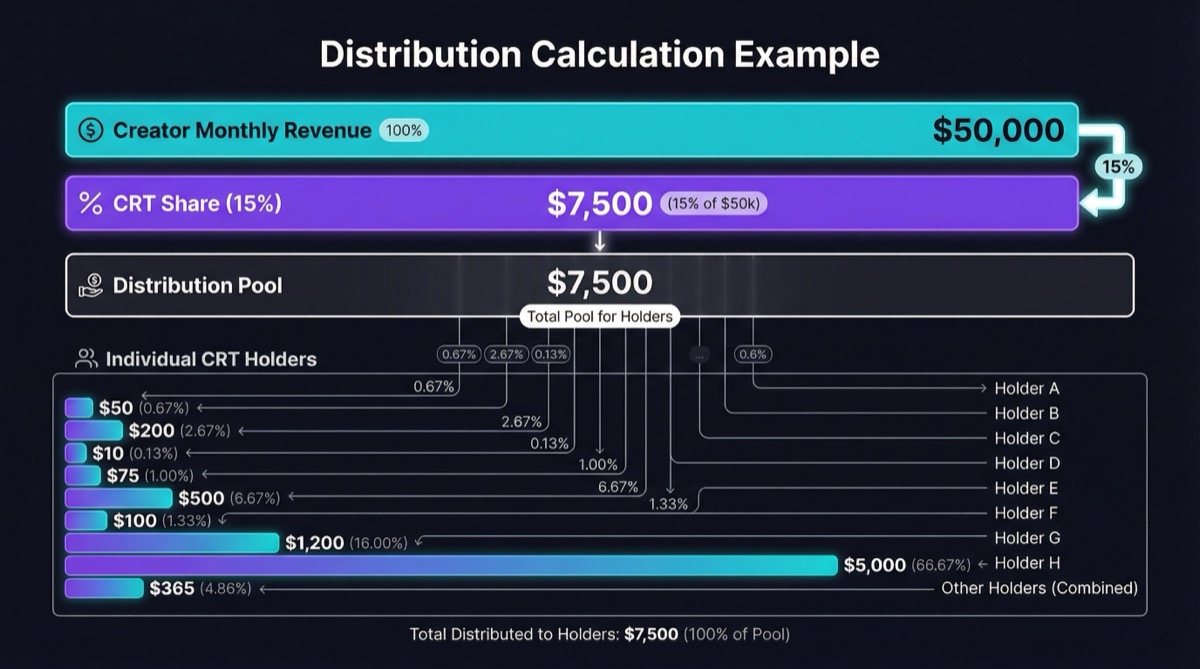
GigaStar applies the revenue-sharing percentage defined in the offering's Form C to the Creator's YouTube revenue. This produces the total distribution pool for all CRT holders. That pool is then divided among individual CRT holders in proportion to the number of CRTs each Investor holds.
Step 5: Funds Are Distributed to Investor Accounts
After the calculation is complete, GigaStar distributes the funds to each CRT holder's account. Investors can view the distribution amount, the date, and the applicable period through their Investor dashboard.
The entire process — from YouTube displaying ads to funds reaching your account — involves multiple entities and processing steps. While the system operates on a regular monthly cadence, slight variations in timing are normal and should be expected.
Distribution Frequency
CRT distributions are paid on a monthly basis. This monthly cadence aligns with YouTube's payment schedule to Creators and provides CRT holders with regular visibility into their investment's performance.
Why Monthly?
Monthly distributions strike a balance between providing timely information to Investors and allowing sufficient time for the revenue cycle to complete. YouTube's AdSense payments operate on a monthly schedule, making monthly the natural cadence for downstream distributions.
Timing Within the Month
The exact date of each distribution within a given month may vary slightly. The timing depends on when YouTube pays the Creator, when GigaStar receives and processes the revenue data, and any operational factors that may affect processing. While the cadence is monthly, you should not expect distributions to arrive on the exact same calendar date each month.
No Skipped Months (Under Normal Conditions)
Under normal operating conditions, distributions are processed every month that the revenue-sharing agreement is active and the Creator's channel generates revenue. However, if the Creator's YouTube revenue for a given period is zero, the distribution for that period would also be zero. This would not be a skipped distribution in a technical sense — it would simply reflect the absence of underlying revenue.
How Distribution Amounts Are Calculated
Understanding the math behind distributions helps set realistic expectations. The calculation is straightforward in principle, though the inputs are variable.
The Core Formula
Distribution to you = Creator's YouTube Revenue x Revenue-Sharing Percentage x (Your CRTs / Total CRTs)
Let's walk through a hypothetical example to illustrate how this works. Note: These numbers are entirely hypothetical and are provided solely for educational purposes. They do not represent actual or expected performance of any Creator or offering.
Hypothetical example:
- A Creator earns $10,000 in YouTube AdSense revenue for a given month
- The revenue-sharing percentage in the offering terms is 5%
- Total distribution pool: $10,000 x 5% = $500
- Total CRTs outstanding: 1,000
- You hold 100 CRTs (10% of the total)
- Your distribution: $500 x 10% = $50
In this hypothetical scenario, your $50 distribution reflects one month's share of one Creator's YouTube revenue. The following month, the Creator might earn $12,000 or $7,000 — and your distribution would adjust accordingly.
What Revenue Is Included
The revenue subject to the sharing agreement is typically the Creator's YouTube AdSense revenue — the money YouTube pays the Creator for advertisements displayed on their videos. This generally does not include other income the Creator may earn, such as:
- Brand sponsorships or paid partnerships
- Merchandise sales
- Membership or subscription revenue (e.g., YouTube channel memberships)
- Revenue from other platforms (e.g., TikTok, Instagram, Twitch)
- Appearance fees, licensing deals, or other off-platform income
The exact definition of "revenue" for distribution purposes is specified in each offering's Form C. Always read the offering documents to understand exactly what revenue is included in the sharing agreement.
Factors That Affect Distribution Amounts
Because distributions are tied to a Creator's actual YouTube revenue, a wide range of factors can influence how much you receive each month. Understanding these factors helps explain why distribution amounts vary.
Channel Viewership
The single largest driver of YouTube ad revenue is viewership. More views generally mean more ad impressions, which generates more revenue. A Creator who publishes a viral video in a given month may see a significant revenue spike. A Creator who takes a break from uploading may see viewership — and revenue — decline.
YouTube Advertising Rates (CPM)
CPM (cost per mille, or cost per thousand ad impressions) is the rate advertisers pay to display their ads. CPM rates vary significantly based on:
- Seasonality: Q4 (October through December) typically sees the highest CPM rates due to holiday advertising spending. January often sees a sharp decline as advertiser budgets reset.
- Audience geography: Viewers in the United States, Canada, the United Kingdom, and Australia typically generate higher CPMs than viewers in many other regions.
- Audience demographics: Advertisers pay more to reach certain demographic groups based on age, interests, and purchasing behavior.
- Content category: Some content niches (e.g., finance, technology, business) tend to attract higher CPMs than others (e.g., entertainment, gaming).
Content Volume and Consistency
Creators who publish content regularly tend to maintain more stable viewership and revenue than those who publish sporadically. Extended breaks from content creation can lead to reduced algorithmic visibility and declining viewership, which in turn reduces revenue.
YouTube Algorithm and Policy Changes
YouTube periodically updates its recommendation algorithm, which determines how videos are surfaced to viewers. Algorithm changes can significantly affect a Creator's viewership, either positively or negatively. Similarly, changes to YouTube's monetization policies (such as adjustments to ad placement rules or eligibility requirements) can affect revenue.
Audience Demographics and Geography
A Creator's audience composition matters. Channels with audiences concentrated in high-CPM regions generate more ad revenue per view than channels with audiences in lower-CPM regions. Shifts in audience geography over time can affect revenue even if total viewership remains stable.
What to Expect Over Time
Setting realistic expectations about distribution variability is an essential part of responsible CRT investing.
Month-to-Month Variation Is Normal
Distribution amounts will not be the same every month. Even for Creators with highly consistent content output and stable audiences, factors like seasonal CPM fluctuations and YouTube's payment timing introduce natural variation. Receiving a higher distribution one month and a lower one the next is standard and expected behavior — not a cause for alarm.
Seasonal Patterns
Many CRT Investors will notice a seasonal pattern in distributions. Q4 distributions (reflecting October through December revenue) tend to be higher due to increased holiday advertising spending. Q1 distributions (reflecting January through March revenue) tend to be lower as advertiser budgets reset. This pattern is driven by the advertising industry and affects virtually all YouTube Creators.
No Guaranteed Minimum
There is no minimum distribution amount. If a Creator's YouTube revenue for a period is very low, your distribution will be very low. If the Creator's revenue is zero, your distribution is zero. You should never rely on CRT distributions as a consistent source of funds.
Revenue Could Decline to Zero
In the most adverse scenario, a Creator's YouTube revenue could decline to zero — whether due to the Creator ceasing content production, YouTube demonetizing the channel, or viewership dropping to negligible levels. If this happens, your distributions stop and your investment could result in a total loss. Past distributions, no matter how consistent, do not predict or guarantee future distributions.
Tax Considerations
CRT distributions may have tax implications that vary depending on your individual financial situation and jurisdiction.
Distributions May Be Taxable
CRT distributions may be subject to federal, state, and local income taxes. The specific tax treatment of CRT distributions depends on multiple factors, including how the revenue-sharing arrangement is classified for tax purposes and your individual tax situation.
Consult a Tax Professional
Tax laws are complex, and the tax treatment of revenue-sharing securities like CRTs may not be straightforward. You should consult a qualified tax professional who can provide guidance specific to your circumstances. Do not rely on general educational content — including this article — as tax advice.
Tax Documentation from GigaStar
GigaStar will provide relevant tax documentation to assist Investors with their tax reporting obligations. This documentation will reflect the distributions you received during the tax year. Retain all documentation and share it with your tax professional when preparing your tax filings.
Key Takeaways
- CRT distributions are monthly payments based on a Creator's actual YouTube revenue, multiplied by the revenue-sharing percentage defined in the offering terms, divided proportionally among CRT holders.
- Distributions are not equity payouts, not interest payments, and not guaranteed. They are contractual revenue-sharing payments that vary based on actual revenue.
- The distribution process flows from YouTube paying the Creator, to GigaStar calculating each holder's share, to funds being distributed to Investor accounts.
- Multiple factors affect distribution amounts, including channel viewership, CPM rates, seasonality, content volume, audience demographics, and YouTube policy changes.
- Month-to-month variation is normal. Seasonal patterns (especially higher Q4 distributions) are common across virtually all YouTube Creators.
- There is no guaranteed minimum distribution. Revenue could decline to zero, resulting in zero distributions and potential total loss of your investment.
- Distributions may be taxable. Consult a qualified tax professional for guidance specific to your situation. GigaStar will provide relevant tax documentation.
- Past distributions do not predict future results. Always approach CRT investing with realistic expectations and invest only what you can afford to lose entirely.
This content is for educational purposes only and does not constitute investment advice. CRT investments involve significant risk, including potential total loss of invested capital. Past performance does not predict future results.
Frequently Asked Questions
How often are CRT distributions paid?
CRT distributions are paid on a monthly basis, aligning with YouTube's monthly payment cycle to Creators. The exact date within each month may vary slightly depending on when YouTube pays the Creator and when GigaStar completes its processing. While the cadence is monthly, distributions will not necessarily arrive on the same calendar date each month.
Are CRT distributions guaranteed?
No. CRT distributions are not guaranteed in any way. They are based entirely on the Creator's actual YouTube revenue, which can fluctuate significantly from month to month based on viewership, advertising rates, content output, and numerous other factors. Revenue could decline to zero, which would result in zero distributions. There is no minimum distribution amount, and you could lose your entire investment.
Why do my distribution amounts change each month?
Distribution amounts vary because they are directly tied to the Creator's actual YouTube revenue, which fluctuates for many reasons. Common causes of variation include changes in viewership, seasonal advertising rate fluctuations (Q4 tends to be highest, Q1 tends to be lowest), changes in the Creator's content output or upload frequency, shifts in audience demographics or geography, and YouTube platform or algorithm changes. Month-to-month variation is normal and expected.
Are CRT distributions taxable?
CRT distributions may be subject to federal, state, and local taxes depending on your individual circumstances and jurisdiction. The specific tax treatment of revenue-sharing distributions can be complex. GigaStar will provide relevant tax documentation to help you report your distributions. You should consult a qualified tax professional for guidance specific to your situation rather than relying on general educational content.