CRTs vs. Other Creator Economy Investments
How do Channel Revenue Tokens compare to other investments?
CRTs are SEC-registered securities with specific characteristics: they represent revenue-share rights (not ownership), are currently illiquid, and have both similarities and differences compared to stocks, crypto, and other alternative investments.
Educational Content: This content is for educational purposes only and does not constitute investment advice. All investments involve risk, including potential loss of principal. See full disclosures.
What Makes CRTs a Distinct Investment
Channel Revenue Tokens (CRTs) occupy a category of investment that does not fit neatly into any traditional asset class. Understanding what makes them distinct is the essential first step before comparing them with anything else.
A CRT is a security — registered with the SEC under Regulation Crowdfunding (Reg CF) — that represents a contractual right to receive a share of a specific YouTube Creator's potential future revenue over a defined period. When you purchase CRTs through GigaStar Market, a FINRA-member funding portal, you are not buying equity in a company, lending money that will be repaid with interest, or acquiring a tradable digital token on a blockchain. You are purchasing a revenue-share agreement with defined terms disclosed in a Form C filing.
This distinction matters because it affects every aspect of the investment: how distributions are calculated, what legal protections apply, what risks you face, and how you should think about CRTs relative to the other investment options available to you. CRTs share certain characteristics with several other investment types — revenue-based distributions like REITs, regulatory oversight like public stocks, speculative risk like venture capital — but they are identical to none of them.
CRTs are offered under Reg CF, which means every offering must file a Form C with the SEC disclosing the terms, risks, financials, and use of funds. This regulatory framework provides transparency requirements that many alternative investments lack. However, Reg CF also imposes limitations: there are annual caps on how much a company can raise, and the securities themselves are subject to holding periods and limited liquidity.
The underlying asset driving CRT value is a single Creator's YouTube revenue. This creates a highly concentrated risk profile. Unlike a stock index fund that spreads risk across hundreds of companies, or a REIT that may own dozens of properties, a single CRT investment is tied to the performance of one individual's content on one platform. That concentration is a fundamental characteristic that Investors must weigh carefully.
CRTs are currently illiquid. While GigaStar Securities operates a Secondary Market — a FINRA-regulated alternative trading system — trading volume is limited, and there is no assurance that a buyer will be available when you want to sell. This is materially different from publicly traded stocks or bonds, which can typically be bought and sold within seconds during market hours.
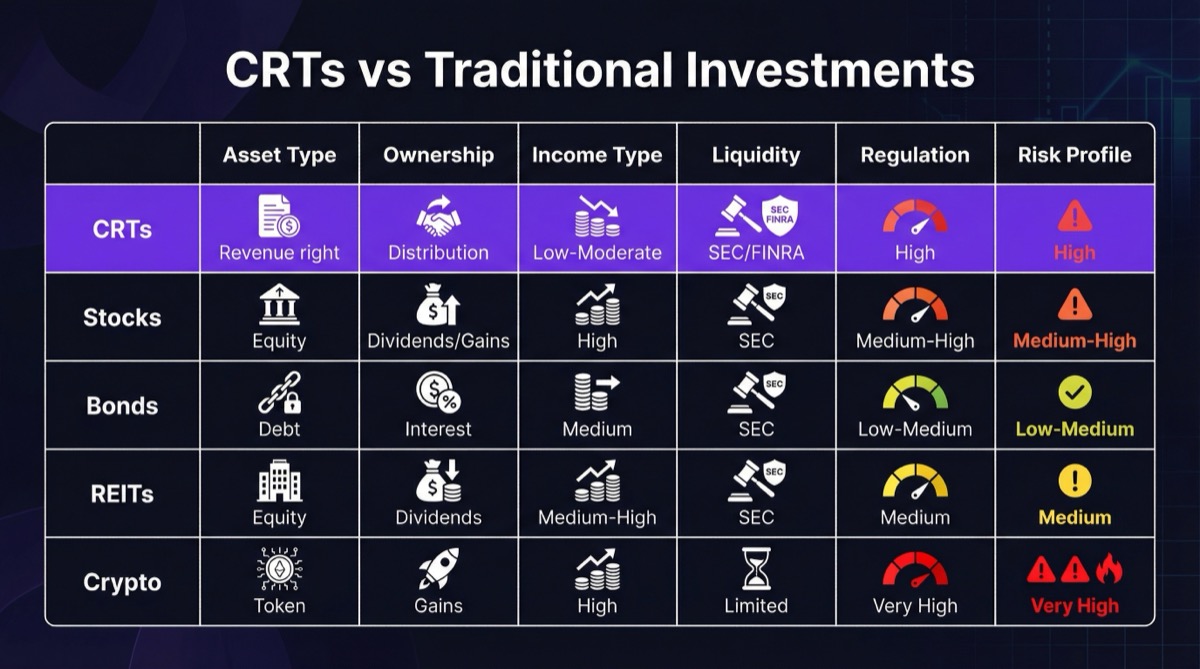
CRTs vs. Stocks
Stocks (equities) are the most widely held investment type in the world. When you buy a share of stock, you are purchasing partial ownership of a company. That ownership typically comes with voting rights, a claim on company assets in liquidation, and the potential for the share price to appreciate as the company grows.
CRTs share none of these ownership characteristics. Purchasing CRTs does not make you a part-owner of a Creator's channel, business, or intellectual property. You have no voting rights, no claim on assets, and no equity stake that could appreciate if the Creator's broader business grows in value. Your CRT entitles you to a defined percentage of YouTube revenue for a defined period — nothing more and nothing less.
The income mechanics also differ fundamentally. Stock investors may receive periodic payments from companies that choose to make them, and stock prices fluctuate based on earnings reports, market sentiment, macroeconomic conditions, sector trends, and countless other factors. CRT distributions are determined by a single, specific metric: the actual YouTube revenue generated by the Creator whose offering you invested in. That revenue depends on factors like CPM rates, view counts, audience retention, YouTube's algorithm, and the Creator's content output.
From a liquidity standpoint, publicly traded stocks on major exchanges like the NYSE or NASDAQ can be bought and sold almost instantly during trading hours, with narrow bid-ask spreads and deep order books. CRTs trade on GigaStar's Secondary Market with significantly less liquidity. Sell orders may remain unfilled for extended periods, and bid-ask spreads may be wide.
Regulatory protections also differ in scope. Publicly traded companies must file periodic reports with the SEC (10-Q and 10-K filings), submit to audits, and comply with extensive disclosure requirements. CRT offerings are filed under Reg CF, which has its own disclosure requirements through the Form C, but the ongoing reporting obligations are less extensive than those imposed on public companies. GigaStar Market is a FINRA-member funding portal, which provides regulatory oversight, but the depth of regulatory infrastructure differs from that surrounding the public equity markets.
One area where CRTs have a lower barrier to entry is the minimum investment amount. Purchasing meaningful positions in individual stocks can require significant capital, particularly for high-priced shares. CRT offerings on GigaStar Market have their own minimum investment thresholds, which are specified in each offering's Form C and are generally accessible to a broader range of Investors.
CRTs vs. Bonds
Bonds are debt instruments. When you purchase a bond, you are lending money to an issuer — a government, municipality, or corporation — in exchange for periodic interest payments (coupons) and the repayment of principal at maturity. Bonds are generally considered lower-risk than stocks, particularly government bonds, because of their fixed payment schedules and the legal obligation of the issuer to repay.
CRTs are not debt instruments. A Creator who raises capital through a CRT offering does not owe Investors a fixed repayment amount. There is no principal to be repaid at maturity, no coupon rate, and no scheduled interest payment. Distributions are entirely variable, based on the Creator's actual YouTube revenue. In months when the Creator generates more revenue, distributions may be higher. In months when revenue declines, distributions decline with it. If revenue drops to zero, distributions drop to zero.
This distinction has profound implications for risk. A bond investor knows (within the bounds of credit risk) what their payment schedule will look like. A CRT investor does not. The variability of CRT distributions means that the investment behaves more like a revenue-sharing arrangement than a fixed-income instrument. This makes CRTs fundamentally unsuitable as a replacement for fixed-income allocations in a portfolio designed around steady, scheduled cash flows.
Bond investors also benefit from credit ratings — independent assessments of the issuer's likelihood of defaulting on payments. No comparable rating system exists for CRT offerings. Investors must conduct their own due diligence on the Creator and their channel, reviewing the Form C, historical revenue data, channel metrics, and risk factors disclosed in the offering documents.
In terms of regulatory treatment, bonds issued by public entities fall under extensive SEC regulation. Municipal bonds have their own regulatory framework. CRTs are regulated under Reg CF — a comparatively newer regulatory pathway designed to facilitate crowdfunding of small securities offerings. Both frameworks provide Investor protections, but the protections differ in nature and scope.
The holding period and liquidity characteristics also differ. Many bonds trade on secondary markets with reasonable liquidity, and bonds have defined maturity dates at which the principal is returned. CRTs have a defined revenue-sharing term, but there is no principal repayment at the end of that term. The Secondary Market for CRTs is operational but has limited trading volume compared to bond markets.
CRTs vs. Real Estate and REITs
Real estate — whether purchased directly or through Real Estate Investment Trusts (REITs) — has long been a popular asset class. Direct real estate ownership involves purchasing physical property that generates rental income and may appreciate in value. REITs allow investors to participate in real estate through publicly traded securities without the responsibilities of property management.
CRTs and real estate investments share a superficial similarity: both can generate periodic income. However, the nature of the underlying asset and the income stream differ significantly.
Real estate is a tangible, physical asset. A building exists regardless of market conditions, algorithms, or platform policies. Its value is supported by the land it sits on, the structure itself, and the demand for the space. YouTube revenue, by contrast, is entirely intangible. It depends on the Creator's ongoing ability to produce content that attracts views, YouTube's continued operation and monetization policies, advertiser demand, and the platform's recommendation algorithm. A single policy change by YouTube could dramatically affect a Creator's revenue in ways that have no parallel in physical real estate.
REITs offer relatively high liquidity (publicly traded REITs can be bought and sold on stock exchanges) and diversification across multiple properties, geographic regions, and property types. A CRT investment concentrates risk in a single Creator on a single platform. There is no built-in diversification mechanism within a single CRT position, although an Investor could choose to invest in multiple Creator offerings to spread risk across channels.
Entry points differ as well. Purchasing direct real estate typically requires substantial capital, a mortgage, and ongoing maintenance costs. Publicly traded REITs can be purchased for the price of a single share. CRT offerings have minimum investment thresholds set by each individual offering, generally designed to be accessible to a broad Investor base under Reg CF.
Tax treatment also varies. Real estate investments benefit from specific tax advantages, including depreciation deductions, 1031 exchanges, and mortgage interest deductions. CRT distributions may be treated as ordinary income for tax purposes, though Investors should consult their own tax advisors for guidance based on their specific situations.
CRTs vs. Cryptocurrency
This comparison requires particular clarity because the word "Token" in Channel Revenue Token sometimes creates confusion. CRTs are not cryptocurrency. They share nothing in common with Bitcoin, Ethereum, or any blockchain-based digital asset beyond the coincidental use of the word "token."
Cryptocurrency operates on decentralized blockchain networks. Crypto tokens are bought and sold on decentralized or centralized exchanges, stored in digital wallets, and their value is determined by supply and demand dynamics in a global, 24/7 market. Cryptocurrency is not regulated as a security in most cases (though this remains an evolving legal question), and most crypto tokens are not backed by any underlying revenue-generating asset.
CRTs are SEC-registered securities. They are offered through a FINRA-member funding portal under Regulation Crowdfunding. There is no blockchain involved. There is no mining. There is no decentralized exchange. CRTs are not stored in a crypto wallet. They exist as securities held in Investor accounts through a regulated process, with ownership recorded through traditional securities infrastructure.
The volatility profiles also differ dramatically. Cryptocurrency prices can swing 10%, 20%, or more in a single day based on social media sentiment, regulatory news, or whale trading activity. CRT value on the Secondary Market is influenced by the underlying Creator's actual revenue performance and Investor demand. While CRT prices can change, the price-setting mechanism is fundamentally different from the speculative, sentiment-driven dynamics that characterize most cryptocurrency markets.
Regulatory protections represent another major divergence. CRT offerings require Form C filings with the SEC, which mandate disclosure of terms, risks, and use of funds. GigaStar Market is a FINRA member subject to regulatory oversight. Most cryptocurrency markets lack comparable regulatory requirements, though the regulatory landscape for crypto is evolving. The result is that CRT Investors have access to standardized disclosure information that is generally not available for cryptocurrency purchases.
The underlying value proposition is also distinct. Most cryptocurrencies derive their value from network effects, technological utility, or speculative demand rather than from a contractual claim on revenue. A CRT's distributions are contractually tied to a specific Creator's actual YouTube revenue — a defined, measurable cash flow stream, even though that stream is variable and uncertain.
CRTs vs. Other Alternative Investments
The broader alternative investment category includes venture capital, private equity, collectibles, farmland, fine art, and other non-traditional asset classes. CRTs share some characteristics with these investments while differing in important ways.
Venture capital and private equity involve investing in private companies, typically in exchange for equity. These investments require long holding periods (often 7-10 years), are highly illiquid, and carry significant risk. Like CRTs, they are not traded on public exchanges. However, venture capital and private equity typically require accredited Investor status and minimum investments of $25,000 to $250,000 or more. CRTs are available to non-accredited Investors under Reg CF, with lower minimum investment amounts. On the other hand, venture capital invests in equity — if a startup succeeds, the potential upside is substantial. CRTs are revenue-share instruments with distributions capped by the terms of the agreement, which do not offer equity-like upside.
Collectibles (art, wine, trading cards, memorabilia) are tangible assets whose value depends entirely on what someone else is willing to pay. They generate no income while held. CRTs differ in that they generate potential periodic distributions based on actual revenue, and they are regulated securities with defined terms. However, both collectibles and CRTs are illiquid and speculative.
Farmland and timber investments offer exposure to real, productive assets with long track records. These often generate income through agricultural production while the land itself may appreciate. CRTs differ in that the underlying "asset" is a Creator's ability to produce content that generates ad revenue — an intangible, human-dependent variable rather than a physical resource.
The key advantage CRTs hold over many alternative investments is accessibility. Reg CF was specifically designed to democratize access to investment opportunities that were previously available only to accredited or institutional Investors. CRT offerings allow participation at lower minimums and without accredited Investor requirements, while still providing SEC-mandated disclosures. The trade-off is that CRTs are a newer, less established type of security with a shorter track record and limited liquidity.
Comprehensive Comparison
The following table summarizes the key differences across investment types. This is a generalized overview — specific characteristics vary widely within each category.
| Feature | CRTs | Stocks | Bonds | Real Estate/REITs | Cryptocurrency | Other Alt Investments |
|---|---|---|---|---|---|---|
| Regulatory framework | SEC Reg CF; FINRA-member portal | SEC-registered; exchange-listed | SEC-registered (corporate); varies (muni/gov) | SEC-registered (REITs); varies (direct) | Evolving; mostly unregulated | Varies widely |
| Minimum investment | Set per offering; generally low | Price of one share | Varies ($1,000+ for most bonds) | One REIT share or significant capital (direct) | Any amount | Often $25K-$250K+ (VC/PE) |
| Liquidity | Limited (Secondary Market with low volume) | High (public exchanges) | Moderate to high | High (REITs) to low (direct) | High (major tokens) to zero (micro tokens) | Very low (years-long lock-ups) |
| Income type | Variable monthly distributions based on revenue | Optional company payments; price appreciation | Fixed coupon payments | Rental income; potential appreciation | Generally none (speculative appreciation) | Varies |
| Underlying asset | One Creator's YouTube revenue | Company equity/earnings | Issuer's creditworthiness | Physical property | Network value/speculation | Varies (companies, tangible assets, etc.) |
| Risk level | High — speculative, concentrated, illiquid | Varies by company/sector | Generally lower (investment-grade) | Moderate (REITs) to high (direct/leveraged) | Very high (volatile, unregulated) | High (illiquid, concentrated) |
| Investor protections | Form C disclosure; FINRA oversight | Extensive SEC reporting | Credit ratings; SEC regulation | SEC regulation (REITs); property law (direct) | Limited | Varies; often limited |
| Ownership stake | None — revenue-share rights only | Yes — equity ownership | None — creditor relationship | Yes (direct) or indirect (REIT) | Token ownership | Varies |
Risk and Characteristics Profile
Any honest comparison of CRTs with other investments must address the risk profile directly. CRTs carry several categories of risk that Investors should evaluate carefully.
Concentration risk is among the most significant. A single CRT investment is tied to one Creator's YouTube channel. If that Creator experiences a decline in viewership, gets demonetized, receives a channel strike, loses audience interest, or simply stops creating content, the distributions from that CRT could decline or cease entirely. Unlike a stock index fund that holds hundreds of positions, or a REIT that owns dozens of properties, a CRT offers no internal diversification.
Platform risk adds another layer. All CRT distributions depend on YouTube's continued operation and monetization policies. If YouTube changes its revenue-sharing terms with Creators, alters its algorithm in ways that reduce a Creator's views, or modifies its monetization eligibility requirements, CRT distributions could be affected — and CRT holders would have no recourse against YouTube.
Illiquidity risk means that Investors may not be able to sell their CRTs when they want to, or at a price they consider acceptable. The Secondary Market exists, but trading volume is limited. Investors should treat CRT investments as potentially illiquid for the full revenue-sharing term.
Speculative nature is inherent to the asset class. CRTs are a relatively new type of security with a limited track record. There is no long history of performance data to analyze, no established benchmarks to reference, and no broad consensus on how to value these instruments. The Creator Economy itself is still evolving, and the long-term trajectory of YouTube as a revenue-generating platform for individual Creators is uncertain.
On the other side of the equation, CRTs are tied to real, measurable revenue. YouTube pays Creators based on actual ad views and engagement. This means that CRT distributions, while variable, are connected to an identifiable and verifiable revenue stream — not to speculative sentiment or theoretical future value. The SEC regulatory framework and FINRA oversight provide transparency and Investor protection mechanisms that many alternative investments lack. And the lower minimum investment thresholds under Reg CF make this asset class accessible to Investors who would be excluded from most venture capital, private equity, or hedge fund opportunities.
The appropriate way to think about CRTs within a broader portfolio is as a speculative allocation — a small portion of an Investor's overall holdings, funded only with capital the Investor can afford to lose entirely. CRTs should complement, not replace, a diversified portfolio.
Key Takeaways
CRTs are a distinct asset class. They are SEC-registered revenue-share securities — not equity, not debt, not cryptocurrency. They have their own set of characteristics that do not map neatly onto any traditional investment category.
No ownership stake is conveyed. Unlike stocks, purchasing CRTs does not give you any ownership, voting rights, or equity interest in a Creator's channel or business. You hold contractual revenue-share rights for a defined period.
Distributions are variable, not fixed. Unlike bonds with scheduled coupon payments, CRT distributions fluctuate based on the Creator's actual monthly YouTube revenue. There is no set minimum or fixed payment schedule.
CRTs are NOT cryptocurrency. Despite the word "Token" in the name, CRTs have nothing to do with blockchain, mining, decentralized exchanges, or crypto wallets. They are traditional securities regulated by the SEC and offered through a FINRA-member portal.
Liquidity is limited. While a Secondary Market exists, CRTs should be considered illiquid. Investors should be prepared to hold for the full revenue-sharing term without the ability to sell.
Risk is real and concentrated. Each CRT investment is tied to a single Creator on a single platform. The speculative nature, concentration risk, platform dependence, and illiquidity mean that total loss of invested capital is a genuine possibility.
Frequently Asked Questions
How are CRTs different from stocks?
Stocks represent fractional ownership of a company. When you own shares, you have an equity stake, which may include voting rights, a claim on company assets, and the potential for the share price to appreciate as the company grows. CRTs convey none of these rights. A CRT is a contractual agreement entitling the holder to a share of a specific Creator's YouTube revenue for a defined period. There is no ownership of the channel, no voting power, and no equity position. The income from CRTs is determined solely by the Creator's actual YouTube revenue, while stock value is influenced by a much broader range of factors including earnings, market conditions, and Investor sentiment.
Are CRTs cryptocurrency?
No. CRTs are securities regulated by the SEC under Regulation Crowdfunding. They are offered through GigaStar Market, a FINRA-member funding portal. The word "Token" in the name refers to the unit of the security — not to a blockchain-based digital token. There is no blockchain technology, no mining, no decentralized exchange, and no crypto wallet involved in CRT ownership. CRTs are recorded and managed through traditional regulated securities infrastructure. The confusion is understandable given the naming convention, but the two are entirely different types of financial instruments operating under entirely different regulatory frameworks.
Can I lose my entire investment in CRTs?
Yes. CRT investments are speculative and carry the risk of total loss. Distributions depend on a Creator's actual YouTube revenue, which can decline or stop for many reasons: the Creator may stop producing content, the channel may be demonetized or struck, YouTube may change its monetization policies, audience interest may shift, or CPM rates may decline. If the Creator's YouTube revenue goes to zero, distributions go to zero. There is no mechanism to recover your principal, no insurance protecting your investment, and no guarantee of any distribution amount. Investors should only invest capital they can afford to lose entirely.
How liquid are CRT investments?
CRT liquidity is limited. GigaStar Securities operates a Secondary Market — a FINRA-regulated alternative trading system (ATS) — where CRT holders may list their holdings for potential sale. However, the market is relatively new and trading volume is low. There is no guarantee that a buyer will be available at any price, and bid-ask spreads may be wide. This is fundamentally different from the public stock or bond markets, where securities can typically be bought or sold within seconds. Investors should approach CRT investments with the expectation that they may hold them for the full revenue-sharing term and plan accordingly.
Should CRTs replace my other investments?
No. CRTs are a speculative, illiquid investment in a relatively new asset class with a limited track record. They should not replace stocks, bonds, real estate, or any other established component of a diversified portfolio. Financial advisors generally recommend that speculative investments represent only a small portion of an overall portfolio — and only an amount the Investor can afford to lose completely. CRTs may be an interesting addition for Investors who want exposure to the Creator Economy through a regulated framework, but they carry significant risks including illiquidity, concentration in a single Creator, platform dependence, and the possibility of total loss. Every Investor should evaluate their own financial situation, investment objectives, and risk tolerance before investing in CRTs.
This content is for educational purposes only and does not constitute investment advice. CRT investments involve significant risk, including potential total loss of invested capital. Past performance does not predict future results.